Remove Net Wrap and Twine
To lighten the workload when feeding hay, we often take shortcuts and leave some twine or net wrap on the bales. And whether we want them to or not, animals eat some of that twine.
There is the potential for twine to accumulate in the rumen of cattle and cause obstruction. Research at North Dakota State University has confirmed this risk and provided further information on what happens to twine when cattle eat it.
In a series of experiments, the North Dakota research first showed that neither plastic net wrap nor biodegradable twine get digested by rumen microbes. The old-fashioned sisal twine, however, does get digested, although quite a bit more slowly than hay.
In another study, net wrap was included in the ration fed to steers for an extended period of time. Then, 14 days before the steers were harvested, the net wrap was removed from the feed to learn if the net wrap eaten earlier might get cleared out of the rumen and digestive system. Turns out it was still in the rumen, even after 14 days.
So, what should you do?
First, remember that it doesn’t appear to be a health concern very often. And obviously, cows are at greater risk than feedlot animals. So, it might be wise to remove as much twine — especially plastic twine — as can be removed easily from bales before feeding. Twine in ground hay may be less of a problem, since more of it is likely to pass completely through the animal.
Think about how shortcuts and work-reducing actions you take this winter might affect your animals. Then act accordingly.
Reducing Hay Feeding Losses
Hay is expensive and many long hours go into harvesting, storing and feeding it. Don’t waste up to a third of it by using poor feeding practices.
Believe it or not, cattle can trample, overconsume, manure on, and use for bedding anywhere from 25% to 45% of your hay when it is fed with no restrictions. Extra control in feeding can pay off big time with that expensive hay.
For starters, don’t provide more than one day’s supply at a time. Research has shown that when cows are fed a four-day supply, they will overeat and waste 20% to 30% more hay than when they are fed one day at a time. This adds up to $50 to $75 more per cow over a four-month feeding period. Best of all is to feed only what the livestock will clean up in one meal, so nothing is left over to be wasted. Be sure to provide sufficient space for all animals to eat at once so boss cows don’t stop timid cows from getting their fair share.
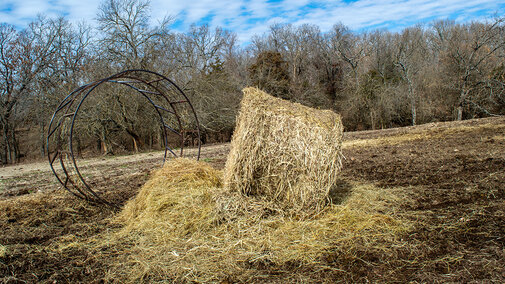
Another thing you can do is restrict access to hay. Use bale racks or rings to keep animals off the hay. Especially useful are racks with barriers around the bottom that prevent livestock from pulling hay loose with their feet and dragging it out to be stepped on. If you unroll bales or grind and feed on the ground, position an electric fence alongside or above the hay to keep cows from trampling or bedding down on the hay.
As always, feed a balanced ration that provides sufficient energy and protein, but not too much. Animals that eat more protein than they need will simply excrete it as extra nitrogen in their urine. This is just as wasteful as directly trampling it into the ground.