Spring Weed Control: Leafy Spurge and Thistles
As pastures begin to green up, now is the time to scout pastures for two persistent problems —leafy spurge and non-native thistles like musk, plumeless and Canada thistle. Both are Nebraska noxious weeds, and early spring is the best opportunity for control.
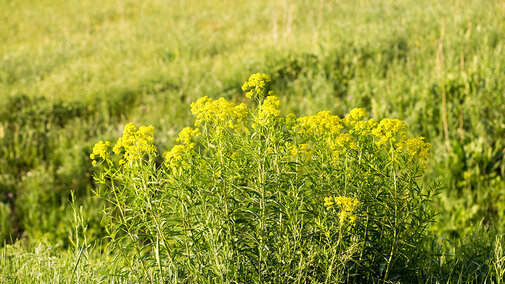
Leafy spurge is a deep-rooted perennial with a yellow-green flower that shows up early in the season. Its root system can reach 15 feet deep, making it extremely difficult to control. Spring herbicide applications at the at the bud stage, include 2,4-D ester, Graslan L, Tordon 22K, or picloram 22K. At flowering, options broaden to products like Curtail, Cody, Stinger, Streamline, Overdrive plus Tordon 22K, or Sharpen plus Plateau can reduce spurge growth and seed production. Just remember — one treatment won’t be enough. A follow-up fall application is often needed to catch regrowth and keep infestations from spreading.
Thistles, especially nonnative species like musk and plumeless, should also be targeted in early spring. Look for plants in the rosette to bolting stage — that’s when herbicides work best. Top-rated products include Chaparral, Milestone, Transline and Opensight, with several other options depending on the specific species. As a perennial, Canada thistle responds best to fall herbicide applications, but you can reduce spread now by mowing in June and July, and applying 2,4-D or a dicamba mix as a stopgap until fall. Just make sure to control before flowers occur.
Whichever weed you’re battling, control efforts need to start early and be followed up throughout the season. Our Nebraska Extension NebGuide EC-130, “Guide for Weed, Disease, and Insect Management in Nebraska” provides a list of recommended herbicide options and cost comparison of spurge, thistle and other noxious weed control products. Read and follow label directions, and don’t wait to control these weeds until they are flowering — by then, your options are limited, control is less effective, and next year’s seed is being spread.
Grass Hay Harvest
Smooth bromegrass and other cool-season grass hay fields are growing rapidly with seedheads beginning to appear. When do you typically cut your grass hay? Ideally, cutting your grass hay so the grass nutrient content matches with the nutritional needs of your livestock is best.
Crude protein and energy concentration declines in grass hay as plants become stemmy and mature. With smooth bromegrass for example, research has shown that crude protein content declines rapidly between boot and mature seed stages. Crude protein levels in well-fertilized hay harvested at early heading range from 10–18%, but drop rapidly after heading. Decreases in crude protein levels by as much as one-half percent per day after heading have been recorded.
Also, keep in mind that plants tend to mature sooner when conditions are dry and temperatures are warmer than normal.
For Sandhills sub-irrigated meadows, haying typically starts in early July. However, if harvest occurs around the third week of June, then that hay will have significantly higher crude protein content. Earlier meadow harvest will have lower initial hay yield, but it will also provide a longer regrowth period and extra growth for fall grazing.
So, a good approach is to plan what type of livestock will receive the grass hay from each field. Young livestock need high nutrient concentrations, so cut that hay before or just when heads begin to emerge. If the hay will go to mature dry cows instead, let the grass produce a bit more tonnage and cut it after it is well headed out, but before seeds develop.
Matching your hay harvest with your plan of use can pay handsome dividends in lower costs and less supplementing.
Alfalfa Weevil Update
Alfalfa weevil continues to be an issue in some fields, particularly those that are established. With recent population spikes and feeding damage observed, alfalfa producers throughout the state are urged to scout for this pest up to and shortly following first cutting.
Plant injury from alfalfa weevil feeding damage appears as pinholes in the terminal leaves, with leaves becoming skeletonized and fields appearing droughty or frosted as feeding severity increases. Larvae are 1.5mm to 8.5mm long with a black head, wrinkled green body, and white stripe along the back and will curl into a C-shape when disturbed.
Scouting for alfalfa weevil is simple and can mitigate yield losses due to feeding damage. First, use a sweep net to determine whether larvae are present. If they are, randomly select five sites across the field and collect 10 stems at each site, cutting the stems at ground level. Beat the stems into a deep-sided white bucket, count the total number of larvae, and divide by 10 to determine the average number of larvae per stem.
Economic thresholds for alfalfa weevil can vary greatly from an average of 1-7 larvae per stem, depending on a variety of factors. If very small larvae are found before the first cutting, it is recommended that the field be scouted after cutting to check for feeding on regrowth.
Insecticides labeled for alfalfa weevil control include pyrethroids and products containing indoxacarb (such as Steward). Pyrethroids are more harmful to natural enemies of alfalfa weevil and resistance may be developing in some weevil populations, while indoxacarb is more selective and may help to maintain beneficial insect populations. When alfalfa reaches 50% or more bud stage, it may be more profitable to cut the alfalfa early rather than treat it.