Drought-Stunted Alfalfa: Cut It or Leave It?
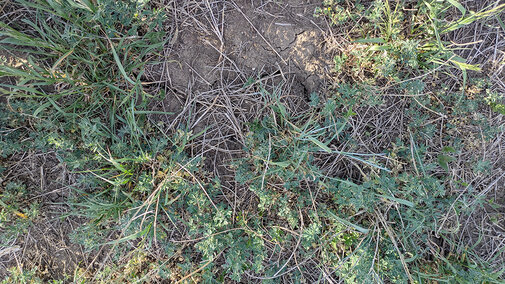
Dry conditions have left some dryland alfalfa fields short, stressed, and slow to grow. When plants are only six to 12 inches tall, turning purple, yellow, or gray, and starting to bloom, the question becomes: should we cut it, graze it, or leave it alone?
The first thing to consider is yield. If the field is not going to produce at least about a half-ton per acre, haying may not pay for the fuel, labor, and equipment cost. From a plant health standpoint, drought-stressed alfalfa can survive while dormant, but every pass across the field still needs to be worth it.
While dormant alfalfa is resilient, the University of Wisconsin recommends not harvesting if the flowering stand is under 10 inches in height. Because quality of drought-stressed stands declines less rapidly with maturity than normal, allowing plants to reach 100% bloom can improve recovery after a harvest does occur.
Grazing can be an option where fence, water and livestock are available. Drought-stressed, bloomed-out alfalfa usually carries less bloat risk than lush, actively growing alfalfa, but the risk is not zero. Avoid turning hungry cattle directly onto alfalfa, offer hay first, and monitor closely.
If grazing, control access with strip grazing or rotation, and try to leave at least four inches of stubble to protect the stand. Once rain comes and fresh regrowth starts, cattle should come off to avoid crown damage and increased bloat risk.
If haying or grazing does not make sense, the best option may simply be to leave the field alone. Shredding may clean things up, but on low-yielding, drought-stunted alfalfa, it often adds cost without much benefit.
The bottom line: base the decision on yield, cost, livestock need, and stand recovery. Protect the crowns, avoid unnecessary expense, and be ready to adjust when rain returns.
Irrigating First Cutting Alfalfa
Alfalfa is resilient to harsh weather and a drought-tolerant perennial crop with rooting depths down eight feet or more. Depending on deep soil profile moisture during drought, some varieties can move into a dormancy and survive up to 45 days without rainfall. However, forage yields drop dramatically, since alfalfa requires about 4 to 6 inches of root available water to produce 1 ton of forage per acre.
So, what irrigation strategy is recommended for alfalfa under extreme moisture stress prior to the first cutting when the first cutting usually requires 6 to 7 inches of water? Also, remember that once perennial fields lack spring moisture, it is hard to catch up with irrigation during the hot summer season due to higher ET (evapotranspiration) water needs.
Most of western Nebraska is currently under extreme drought despite some recent welcome rains.
For example, average North Platte snow/rainfall accumulation from November to May is 10 inches. This year, the snow/rainfall total has been only 3 inches or about 30% of average. So, first cutting yields may be only half of normal forage yield if irrigation has been limited. Also, stressed alfalfa — which may be dropping leaves prematurely — may need cut before the recommended 1/10th bloom alfalfa development stage to salvage yield. Remember that internode length shortens during dry conditions, so forage maturity will have less impact on quality. However, a timely irrigation just prior to the first cutting may increase regrowth tonnage for the succeeding crop.
Moving forward, an advantage of early alfalfa cutting is that water use will drop sharply because transpiration is lower when the leaf foliage is removed. Following first cutting, irrigation might be delayed slightly in fields where weeds could respond quicker to the moisture than alfalfa regrowth.
Otherwise, full water irrigation or rainfall target amounts will be typically six to seven inches of water for each subsequent cutting. Spring water usage may only be ¼-inch per day but will rapidly increase as summer temperatures rise. Peak water alfalfa usage in July and August can extend beyond the normal 1/3-inch per day (or two inches per week) to ½-inch per day during extreme stress times.
Livestock Water on Pasture
As late spring and summer temperatures begin to heat up and cattle are on pasture, it’s important to make sure there is adequate water for livestock. How much do cattle need and where should it come from?
The water requirements for cattle depends on their size, class and environmental conditions. High humidity and greater temperatures also increase water demand. A study at the University of Georgia lists water requirements for days when the daily high temperature is 90°F. With these conditions, growing or lactating animals need two gallons of water per 100 pounds of body weight. This means a 1,400-pound lactating cow will need close to 28 gallons of water daily with 90°F daily highs. If the calves are 250 pounds, they will need about 5 gallons. Again, some of the water will come from grazed forage. Make sure water tanks or water points are accessible for smaller calves.
Having fresh, clean water should also be a priority. Whenever dry conditions occur or especially in later summer, water quality from water sources such as dugouts or ponds and dams may not be ideal. The ability to have water close by should also be a goal, although sometimes it’s simply not possible. More water locations can help meet the water demand but could also help grazing distribution too. Cattle will receive some of their daily water requirements when they are consuming high moisture feedstuffs such as fresh forage when grazing pasture, silages or green chopped feeds. Feeds that are high-energy increase the water requirement.
Keep an eye on water this summer and make sure livestock have enough good quality water available.