Since 2005, wheat stem maggot (WSM) damage has been sporadically reported in corn fields that were green planted into wheat or rye cover crops in eastern Nebraska. In 2017 and 2025, outbreaks of this pest occurred in central and southern Nebraska.
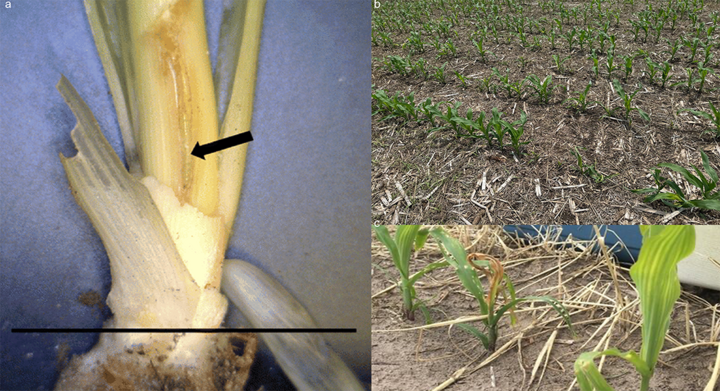
WSM injury occurs when larvae move from infested, dying cover crops into adjacent corn plants, entering near the first node and tunneling into the cornstalk (Figure 1a), destroying the growing point and halting normal vertical growth, which may result in plant death.
Early-season injury can result in uneven plant height and stand loss (Figure 1b), with injury ranging from 1% to 60% of plants. Corn plants that survive larval feeding can show dead leaves in the whorl (“dead heart”) (Figure 1c), excessive tillering (Figure 1b), and delayed development, resulting in unacceptable yield losses in some fields.
More information about the seasonal occurrence of this pest can be viewed in this article, “WSM: an emerging pest of cover crop to corn transition systems (Carmona et al. 2019)”. Corn injury from WSM has been closely linked to planting corn into living rye or wheat cover crops, commonly referred to as “green planting.”
Delaying cover-crop termination until corn is planted allows growers to maximize weed suppression and soil health benefits.
Due to the sporadic nature of WSM, Nebraska Extension has initiated a WSM adult and larval monitoring system in wheat or rye cover crops. The alert system will rely on a network of extension educators and corn producers across several counties, with priority given to regions with reports of previous infestations. The system will also be used to detect infested fields, support insecticide-timing trials, and host pop-up field days to give nearby farmers hands-on WSM scouting experience.
Infestation updates or field monitoring requests can be submitted through an online form.
There are currently no validated recommendations for this pest, and tank-mixing an insecticide with an herbicide at cover crop termination is not recommended, as larvae are likely to remain in the cover crop for several days after application. When the risk of WSM is high, a delayed application targeting the movement of larvae from cover crop to corn is more likely to provide control, but the timing and type of insecticide are unknown. Application after larval infestation in corn is unlikely to provide control due to the larval feeding location within the corn plant.