This article is part of the "Soil Health Stories" series on CropWatch, featuring Nebraska farmers and ranchers. Each month, we highlight producers who are demonstrating innovative practices and practical lessons that can inspire others across the state.
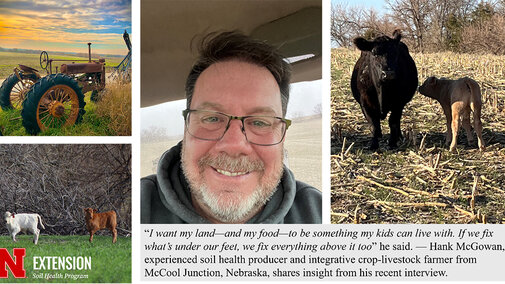
Hank McGowan farms near McCool Junction, Nebraska, on land once so eroded that his family ran road scrapers every winter just to keep fields operable. Today, those scrapers sit idle.
“I haven’t moved them in five years,” McGowan said. “Our erosion’s gone, the soil’s breathing again.”
A proud University of Nebraska–Lincoln alumnus, McGowan studied animal science and credits UNL for sparking his curiosity about biology and systems thinking.
“I could have stayed there forever,” he joked. “That place taught me how everything connects — animals, people, and now, I realize, the soil too.”
From Struggle to Stewardship
When conventional methods no longer made sense — mechanical shaping, heavy tillage and rising input costs — McGowan turned to soil health about five years ago. His initial motivation was simple: extend grazing for his 200 head of beef cows. He planted rye cover crops supported by a small cost-share program.
“The change was unbelievable,” he said. “Scours, pneumonia — all gone,” McGowan noted. “Calves were hitting 300 pounds in 75 days. The cows just looked healthier.”
That result started a chain reaction across his operation and among neighbors.
“When they saw how much better our livestock looked, people started paying attention,” he said.
McGowan soon discovered the soil itself was responding too. Within just two years, organic matter rose 2% to 3% in test sites. The land’s infiltration rates improved, water stayed where it fell, and ditches stopped forming.
“On some of this ground, we used to say it shouldn’t even be farmed,” McGowan said. “Now it’s thriving.”
Learning, Failing, and Finding Support
When Hank first began investigating soil health practices, few local examples existed.
“We were all just figuring it out, mostly learning what not to do,” he said.
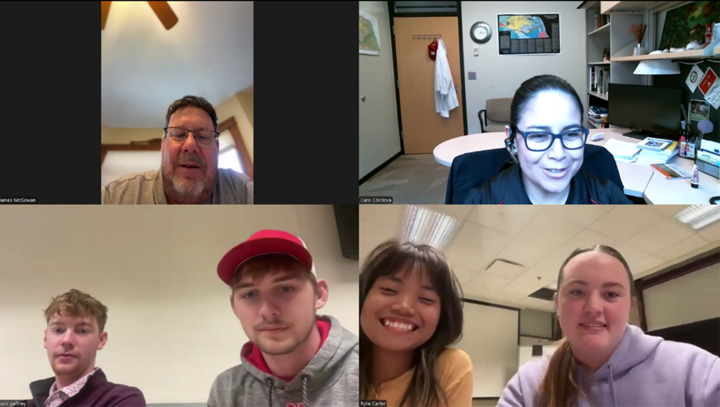
But when Nebraska Extension stepped in to organize a monthly soil health roundtable, things shifted.
“We meet once a month — nine of us farmers swapping stories and screwups,” McGowan said. “That small network’s been one of the best things UNL has done for soil health around here.”
He praised the role of UNL educators for connecting research with on-farm reality.
“Having someone like Caro Córdova pull us together — well, that’s changed everything,” he added. “I finally feel like the university is listening to farmers and learning with us.”
Building Healthy Soil: His Formula
When asked what soil health means, Hank’s answer was clear: “It’s life. It’s a living system that feeds you if you stop fighting it.” For him, that means integrating livestock, minimal disturbance and biology-focused inputs.
“Livestock are your cheapest biological package,” he explained. “Their natural flora feeds soil microbes. Every time they move, eat, and return nutrients, you’re making biology work the way nature designed.”
For fields without livestock, McGowan recommends trying humic acid and tracking responses with soil health tests like Haney, PLFA, sugar amino nitrate and total nutrient digestion.
“You’ve got to learn to measure progress differently,” he said. “And when you compare those tests year after year, you can see soil recovering.”
This tracking not only improved his efficiency but helped earn his banker’s confidence.
“I showed him the data. I applied 120 pounds of nitrogen last year and had 130 pounds left over. Phosphorus was up too,” he said. “That’s proof right there.”
Finding Profit Through Curiosity and Community
In 2019, Hank experimented with non-GMO corn after floods made replanting expensive.
“It was an accident, really,” he said. “But the non-GMO corn yielded the same — and had no insect pressure.”
When he later learned from a fellow farmer that higher-sugar plants deter insects, the pieces clicked.
“Turns out, when you build carbon and life in your soil, nature fights off pests for you,” McGowan said.
He now views soil health as the most future-ready risk management tool. The profitability, once invisible, is becoming clear.
“A few years ago, I couldn’t see how this would make money,” McGowan said. “Now, I don’t see how we can afford not to do it.”
Challenges and Change of Mindset
Adopting regenerative practices hasn’t been easy. Equipment costs, labor needs and slow payback periods test farmers’ patience.
“You don’t get your return in one year — it takes two or three,” he said. “That’s tough on the banker’s spreadsheet.”
Still, Hank believes the long-term benefits outweigh short-term costs.
“We’re feeding the soil again instead of just feeding crops,” he added. “And that makes every year a little easier.”
He admitted some neighbors still laugh about his approach.
“They call me the witch doctor,” he said with a grin. “But last week one of them borrowed my humic acid spreader — that tells me we’re getting somewhere.”
Advice to Other Farmers
Hank’s tips for building healthy soil echo the lessons he’s lived:
- Start with cover crops and livestock — nature’s quickest restorers.
- Use biological tests to guide management instead of guessing.
- Join your local Nebraska Extension network; learn from neighbors.
- Don’t fear failure. “Most of us learn what not to do first.”
- Be patient: “Soil health’s like raising livestock — it takes time and care.”
Looking Ahead
Hank’s next step is bringing mob grazing to his operation using virtual fencing collars.
“We’ll rotate cattle more efficiently, keep the biology active, and get even better soil life. That’s the future,” he said.
To him, building healthy soil is about responsibility.
“We’ve been using products we couldn’t safely touch,” he reflected. “I want my land — and my food — to be something my kids can live with. If we fix what’s under our feet, we fix everything above it too.”
More Information
Want to hear Hank McGowan’s full story in his own words?
Listen to the full interview recording:
Share Your Soil Health Story
For more Soil Health Stories, or to share your own, contact Carolina Córdova, UNL Soil Health Team.