Early Scouting for Alfalfa Weevil Recommended
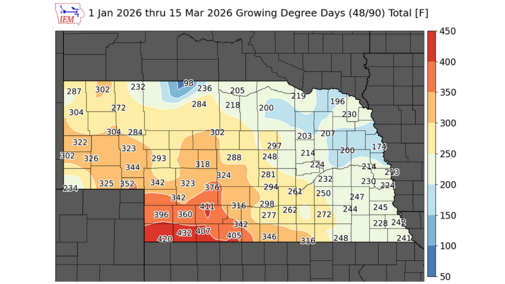
The incredibly mild winter we’ve experienced this year has accelerated the accumulation of growing degree days for one of our most significant forage pests — alfalfa weevil. For example, areas in southwestern Nebraska have accumulated an average of 318 growing degree days compared to 134 at this time last year. In addition, Kansas State University recently announced that weevils are already active in Kansas. These factors indicate that early scouting for alfalfa weevil is critical this year.
In Nebraska, alfalfa weevil scouting is generally recommended once 200 growing degree days have accumulated. The western half of the state west of U.S. Highway 281 is at or well beyond this mark and the eastern half of the state isn’t far behind. Alfalfa producers are urged to begin scouting now, especially in fields that have broken dormancy. For fields that are still fully dormant, feeding damage from alfalfa weevil is less of a concern because they require green, growing foliage to thrive.
While there are several insecticides labeled for alfalfa weevil management, in Nebraska there have been reports of some products not performing as well as expected and resistant alfalfa weevil populations have been reported in several western states. Therefore, if you believe you have a significant early season infestation, contact your county extension office for further guidance.
Planning Summer Grazing
With a new growing season just around the corner, it is time to finalize the coming spring and summer’s grazing and forage plans. Last fall and this winter have been dry, leaving most parts of the state in some level of drought. While we do not know for certain how much moisture lies ahead, long-term forecasts into this spring and summer suggest the possibility of drier than-normal conditions.
With the possibility of droughty conditions for the coming season, an important first step is to develop or adjust a good forage and grazing drought plan for your operation. Some components of this might include stocking rates, turnout dates to summer pastures, purchasing any supplemental hay or feed, securing additional pasture, fertilizer decisions on introduced grass pastures, or seeding of any annual forages.
For spring or cool-season annual forages, the recommended planting period of late March to early April will be here soon. Forages would include things like oats, spring barley, spring triticale and field peas. With that planting date, these would provide grazing beginning in late May through early July.
For the summer annual forages, the planting period is typically late May into the summer months. This would include things like forage sorghum, sudangrass, sorghum-sudan hybrids, pearl millet and foxtail millet. Additionally, other species or legumes that are typical of some cover crop mixes could be part of the package as well. With a late May or early June planting of a summer annual, grazing should be available in July.