Alfalfa Weevil Resistance to Pyrethroids
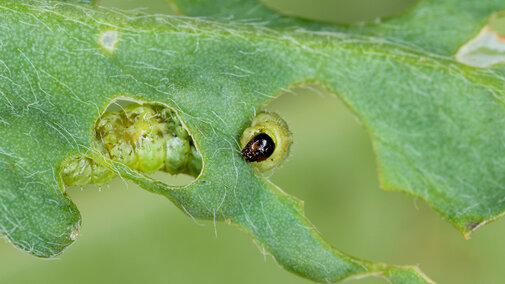
Alfalfa weevil is a serious pest of alfalfa and can cause significant damage, usually in April and May before the first cutting. Reports of reduced efficacy of pyrethroids in Nebraska as well as confirmed resistance to pyrethroids in several western states led to a project in 2025 to determine if Nebraska weevil populations are developing resistance.
During the 2025 season, alfalfa weevil larvae were collected from 12 counties across the state, including the Panhandle, southwest, south-central and eastern Nebraska. The larvae were shipped live to the PREEC Entomology Lab in Scottsbluff, where they were exposed to the label rate of two types of pyrethroid insecticides: lambda-cyhalothrin and permethrin.
The study found that five of the 12 weevil populations had 90% or less mortality when exposed to lambda-cyhalothrin. This indicates that some Nebraska weevil populations may be losing susceptibility to lambda-cyhalothrin. In contrast, all 12 weevil populations had a 100% mortality rate when exposed to permethrin.
What does this mean for alfalfa weevil management?
Currently, there are only two insecticide modes of action available for chemical control of this insect: pyrethroids and indoxacarb (Steward). Because of this, resistance management and the use of alternative control methods is critical. Make sure to scout and only spray when thresholds are reached, use the highest labeled rates, rotate control measures to delay resistance development.
If you believe you have reached the treatment threshold for alfalfa weevil, contact your local extension office for confirmation and guidance for selecting the best management option.
Expectations for Old Hay
Putting up hay is really a way of preserving forage by limiting moisture. As long as hay stays dry, it stays stable. While we often assume older hay means lower quality, losses are usually less about age and more about storage — once moisture shows up, quality begins to slip.
And we actually have proof of that. There are documented bales put up in the Sandhills in the late 1940s that were stored dry for decades, and even when tested in 2024, quality wasn’t nearly as poor as you’d expect. That tells us age alone isn’t driving quality loss — storage conditions are.
In real-world conditions, anytime a bale gets warm and wet enough, microbes become active again. As they grow, they use the bale itself for energy, which means we’re losing dry matter — that feed is literally disappearing.
That dry matter loss usually shows up first as a decline in TDN. Microbes go after the most digestible, high-energy parts of the plant, leaving behind more fiber and less usable energy.
Crude protein is more complicated. We can lose protein through leaf shatter or weathering, but because protein is measured as a percentage of dry matter, it doesn’t always decline the same way energy does. Moisture and heating can also damage protein and reduce availability.
Finally, a lot of quality loss in outside-stored hay is concentrated on the outside of the bale — especially round bales, where a major portion of the total bale resides. Cows often sort and refuse the more highly weathered material, so actual intake can be much lower than a forage test suggests.
Despite that issue, forage testing older hay is critical — it’s the best way to get an accurate picture of what your cattle are actually consuming and to make sound feeding decisions.