Key Takeaways
Wheat creates a valuable cover crop window. Early wheat harvest gives summer legumes more time to establish and grow than is typically available following corn or soybean harvest.
Legumes provided meaningful nitrogen credits. Apparent N credits averaged about 49 lb N/acre across legume treatments and ranged from about 29 to 88 lb N/acre.
Corn benefited from the additional nitrogen. Corn following legumes produced about 40 bu/acre more grain in 2021 and 36 bu/acre more in 2024 than the fertilized no-cover-crop treatment.
Species selection matters. Hairy vetch, sunn hemp, cowpea and forage pea performed particularly well, while cereal rye reduced N availability under the conditions of this study.
Winter wheat creates a valuable opportunity for Nebraska growers interested in growing some of their own nitrogen. Because wheat is typically harvested by early July, producers planting a legume cover crop after wheat have up to three months before the first frost, considerably more growing time than is usually available following corn or soybean harvest.
Why Grow Cover Crops After Winter Wheat?
The post-harvest period following winter wheat can also be important for nitrogen (N) management. During the fallow period after wheat, warm soil conditions favor nitrogen mineralization, which converts organic nitrogen into forms plants can use. Without actively growing roots, nitrate can accumulate in the soil and become vulnerable to loss during winter and early spring. Summer cover crops can take up some of this nitrogen, while legumes can also fix atmospheric nitrogen and add to the nitrogen pool to the cropping system.
Evaluating Cover Crops After Winter Wheat
To evaluate how post-wheat cover crops affect nitrogen availability and the following corn crop, researchers conducted a study at UNL's Rogers Memorial Farm near Lincoln in a rainfed, no-till winter wheat–cover crop–corn–soybean rotation. Cover crops were grown following wheat in 2020 and 2023, with corn evaluated in 2021 and 2024.
Researchers compared several legumes, including hairy vetch, soybean, cowpea, sunn hemp, Austrian winter pea, forage pea and a legume mixture, with cereal rye and no-cover-crop controls (with and without N). Each treatment was replicated three times. Cover crops were seeded on July 19, 2020, and July 23, 2023. Cereal rye and Austrian winter pea were planted late on Sept. 15, 2020 and Sept. 1, 2023, to avoid high temperatures. A CrustBuster (Model 4615-24) planter was used to drill cover crops at 7.5-inch row spacing.
Biomass sampling was done on Oct. 27, 2023, before the first freeze.
Cover crops were winter-killed except for cereal rye, Austrian winter pea and hairy vetch, which were terminated on April 11, 2021, and April 9, 2024, with a mixture of residual and contact herbicides (Corvus, atrazine, 2,4-D and glyphosate) a week before fertilizer application and two weeks before corn planting.
Table 1 provides the cover crop species and corresponding seeding rate used in this study.
| Treatment | Cover Crop (CC) Species | Seeding rate (lb/ac-1) |
| 1 | Cereal rye (Secale cereale L.) | 60.69 |
2
| Chickling vetch (Lathyrus sativus L.) — 2020 4010 Forage pea (Pisum sativum) — 2023 | 89.99 50.56 |
| 3 | Austrian winter pea (Pisum sativum subsp. arvense) | 60.69 |
4
| Legume Mixture 1a. Chickling vetch — 2020 1b. 4010 Forage pea — 2023 2. Hairy vetch (Vicia villosa L.) 3. Soybean [Glycine max (L.) Merr] 4. Cowpea (Vigna unguiculata L.) 5. Sunn hemp (Crotalaria juncea L.) |
15.99 12.00 4.00 14.99 12.32 3.00 |
| 5 | Hairy vetch | 20.22 |
| 6 | Soybean | 60.69 |
| 7 | Cowpea | 50.56 |
| 8 | Sunn hemp | 15.17 |
| 9 | N Control | N/A |
| 10 | N0 Control | N/A |
Note: Chickling vetch was replaced by 4010 Forage pea in 2023 due to seed unavailability.
Corn hybrid, Dekalb (DKC62-00RIBAR2VT3P), was planted on April 28, 2021 and April 23, 2024, maintaining a plant population of 32,000 ac−1. To better quantify the nitrogen contribution from the cover crops, corn following the cover crop treatments received a relatively low fertilizer rate of about 51 lb N/acre, except for the N0 control treatment. We measured cover crop biomass and nitrogen accumulation, soil nitrate availability, corn nitrogen uptake, crop canopy nitrogen status, grain yield and apparent nitrogen credits.
Legumes Accumulated Substantial Nitrogen
Cover crop performance varied considerably among species. Sunn hemp and the legume mixture produced the greatest biomass, at roughly 7,700 lb/acre of dry matter, while cereal rye and Austrian winter pea produced less than 700 lb/acre (Figure 1).

Hairy vetch and soybean accumulated particularly large amounts of nitrogen in their biomass (Figure 2). Hairy vetch accumulated about 158 lb N/acre, while soybean accumulated about 168 lb N/acre. In comparison, cereal rye accumulated only about 23 lb N/acre.

These differences influenced nitrogen availability for the following corn crop. Hairy vetch had the greatest preplant soil nitrate concentration and maintained greater nitrate availability through much of the corn growing season (Figure 3). Across the season, hairy vetch increased soil nitrate-N availability by 154% compared with the N0 control and 111% compared with cereal rye.

More Available Nitrogen Increased Corn Yield
The increased nitrogen supply from legumes translated into greater corn productivity.
Compared with the fertilized no-cover crop treatment, corn following legumes produced a approximately 40 bu/ac more grain in 2021 and 36 bu/ac more in 2024 (Figure 4). Hairy vetch, sunn hemp and forage pea increased corn yields the most.
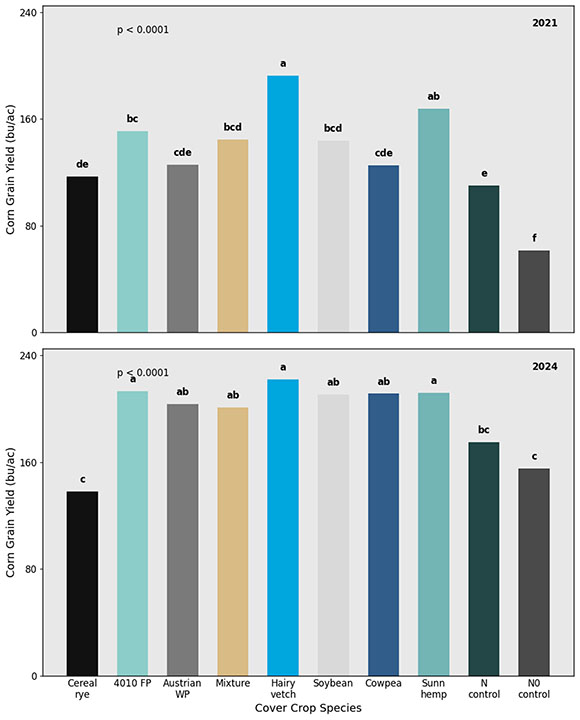
In 2024, all cover crops except cereal rye significantly increased corn grain yield. Higher seasonal soil nitrate availability and stronger crop canopy nitrogen status were also closely related to greater grain yield, indicating that nitrogen released from legume residues contributed to corn performance.
How Much Fertilizer Nitrogen Could Legumes Replace?
One of the most practical findings from the study was the estimated apparent nitrogen credit — the amount of fertilizer N the cover crop could potentially replace — provided by individual legume species (Figure 5).
Legume nitrogen credits ranged from about 29 to 88 lb N/acre (Figure 5). Hairy vetch provided the greatest apparent nitrogen credit at about 88 lb N/acre, followed by cowpea at about 56 lb N/acre. Forage pea and sunn hemp each contributed approximately 48 to 49 lb N/acre.

Across the legume treatments, the average apparent nitrogen credit was about 49 lb N/acre.
These results indicate that legume cover crops grown after winter wheat can contribute enough nitrogen to meaningfully reduce fertilizer requirements for the following corn crop. However, the amount of nitrogen available to corn will depend on cover crop species, biomass production, weather, soil conditions, termination timing and residue decomposition.
Cereal Rye Had a Different Effect
Cereal rye behaved differently from the legumes. Under the conditions of this study, rye produced relatively little biomass and accumulated less nitrogen. It also reduced nitrogen availability to the following corn crop.
The apparent nitrogen credit for cereal rye was negative, suggesting that approximately 41 additional pounds N per acre would have been needed to achieve nitrogen uptake comparable with the fertilized no-cover treatment. This may be primarily due to nitrogen immobilization during residue decomposition, when soil microbes temporarily tie up plant-available nitrogen.
The cereal rye results should be interpreted within the conditions of this experiment. Rye was planted later than most of the summer legumes, and corn was intentionally supplied with a relatively low fertilizer-N rate so we could better detect nitrogen contributions from the cover crops.
The finding does not mean cereal rye lacks value as a cover crop. Rather, it highlights that grass and legume cover crops can affect nitrogen availability very differently, and those differences should be considered when developing a fertilizer program for the following corn crop.
What Does This Mean for Nebraska Producers?
For producers including winter wheat in their rotations, the post-wheat period can provide an excellent opportunity to establish summer legumes. Hairy vetch, sunn hemp, cowpea and forage pea were particularly effective at improving nitrogen availability and corn performance in this study.
The results also indicate that nitrogen supplied by legume cover crops could reduce fertilizer N requirements. Apparent nitrogen credits ranged from about 29 to 88 lb N/acre, although actual fertilizer adjustments will depend on field conditions and cover crop growth.
Species selection is especially important. Species such as sunn hemp and the legume mixture produced substantial biomass; however, hairy vetch and soybean accumulated the most nitrogen. Second, legumes can add biologically fixed nitrogen and release that nitrogen during decomposition, whereas grasses such as cereal rye may temporarily tie up nitrogen and increase the need for supplemental fertilizer.
Bottom Line
Integrating summer legumes following winter wheat offers Nebraska producers an opportunity to add biologically fixed nitrogen to the cropping system.
Under the conditions of this eastern Nebraska study, legume cover crops increased soil nitrate availability, improved corn nitrogen uptake and increased grain yield. They also supplied apparent nitrogen credits ranging from about 29 to 88 lb N/acre, demonstrating their potential to reduce fertilizer nitrogen requirements for the following corn crop.
For growers already including winter wheat in their rotations or considering greater crop diversification, summer legume cover crops could provide both an additional conservation practice and a meaningful source of nitrogen for the next corn crop.
References
- Adhikari, M., Jasa, P. J., Birru, G., & Iqbal, J. (2026). Summer legumes following winter wheat boost soil nitrogen availability and corn yield. Agronomy Journal, 118, e70269. https://doi.org/10.1002/agj2.70269