Key Takeaways
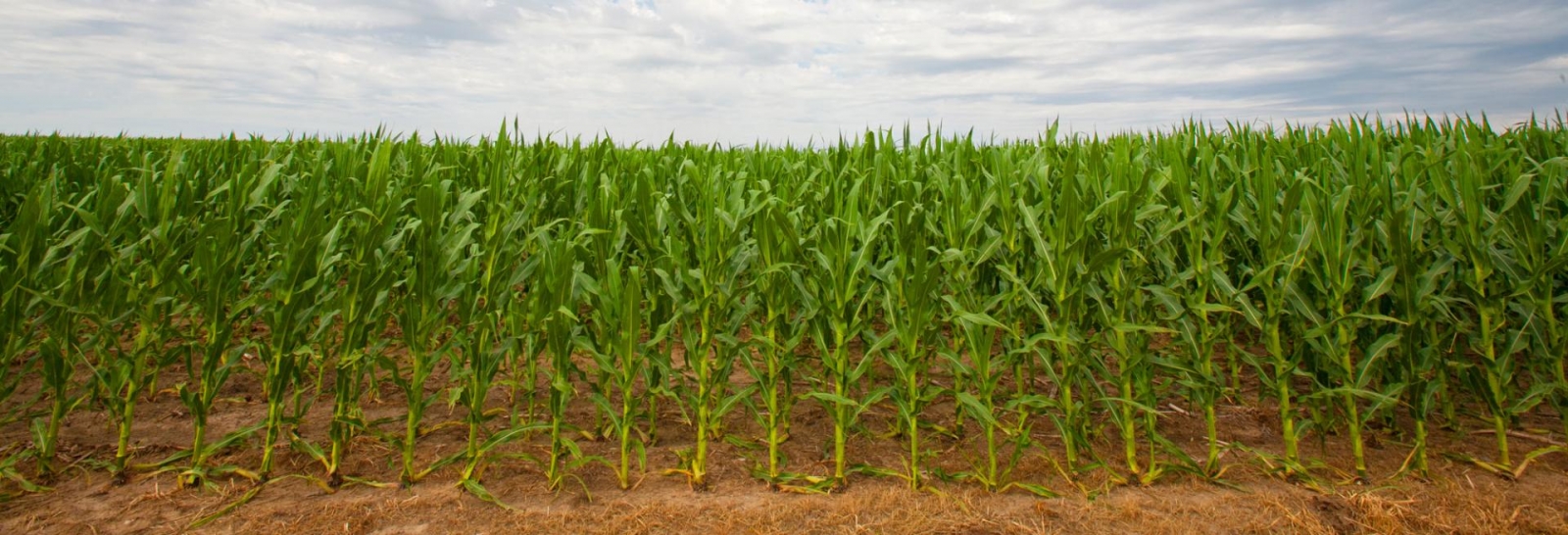
Full-season cover crops provide continuous habitat across summer, fall and winter, offering a unique opportunity to support beneficial insects and wildlife during periods when conventional row-crop systems provide little habitat.
A preliminary study sampled both beneficial and potential pest insects in seed corn production and full-season cover crops in the seed corn isolation acres in Butler County, Nebraska during the 2025 growing season.
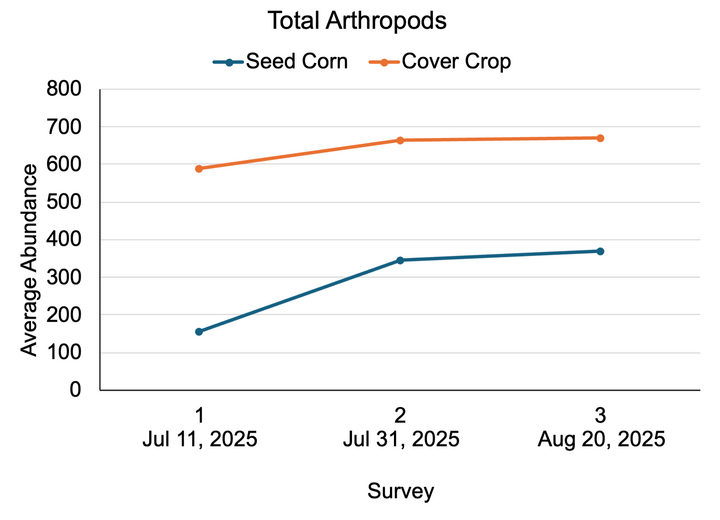
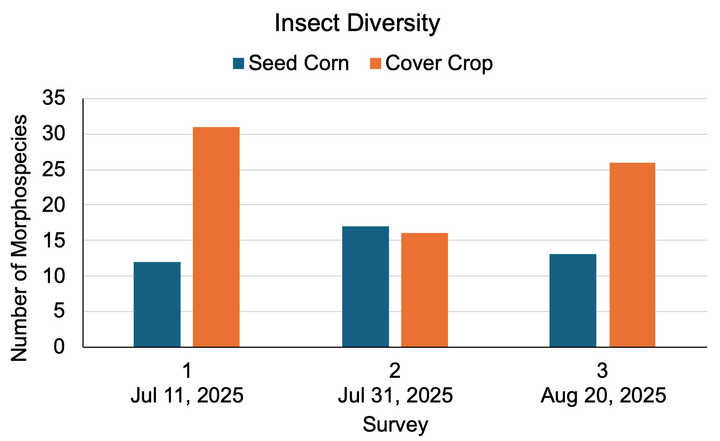
Cover crops supported about 2x higher insect abundance overall and higher diversity of species compared to seed corn.
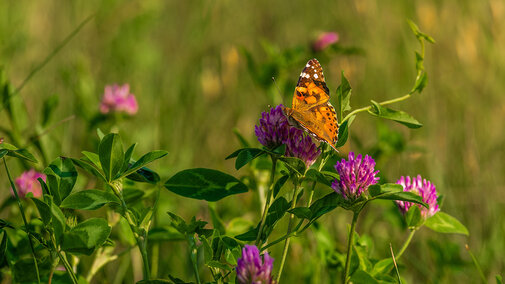
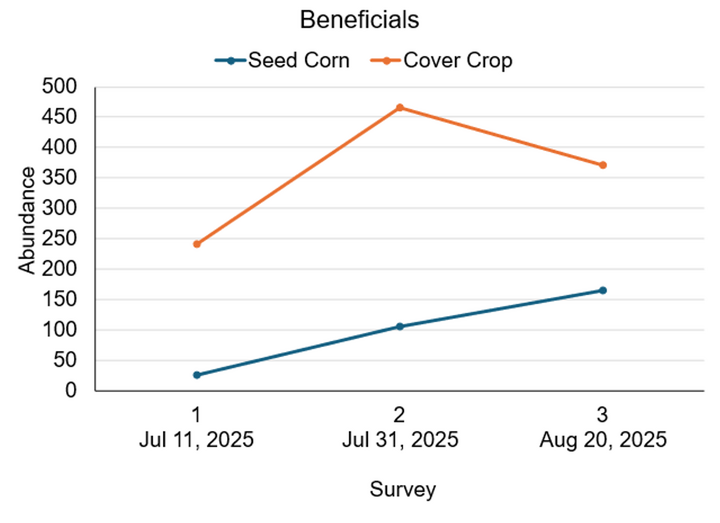
Beneficial insects (pollinators, predators and other natural enemies) were consistently more abundant in full-season cover crops compared to the seed corn field.
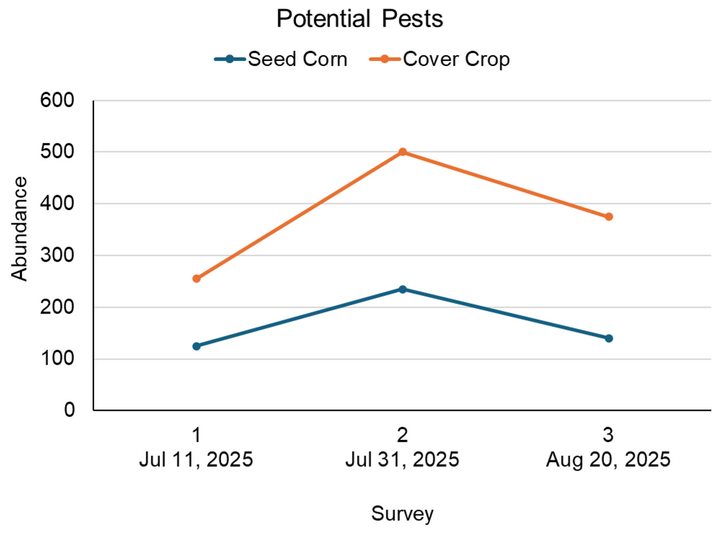
Potential pests were also generally more abundant within the full-season cover crops; however, more research is needed to determine whether this can lead to higher crop injury or impact yields.
Full-season cover crops may offer more than soil and wildlife benefits — they can significantly increase insect activity in agricultural fields. A 2025 study in eastern Nebraska found higher insect abundance and diversity in cover crop areas compared to adjacent seed corn, including both beneficial species and potential pests.
What are Full-Season Cover Crops?
Full-season cover crops (FSCCs) represent a largely untested opportunity to create “win-win” outcomes for agricultural production and natural resource conservation. FSCCs are planted before June 1 in year one and remain standing until March 15 in year two, spanning multiple critical stages in supporting wildlife, especially pheasants.
Unlike short-season cover crops such as cereal rye — which are typically fall-planted and spring-terminated — FSCCs persist through the summer, fall and winter. This extended growth period provides habitat when it is most limited following row-crop harvest.
Today, the FSCC practice is available in 13 counties within eastern Nebraska’s agriculturally-dominated landscape. This competitive practice operates off a limited budget, so contracts are ranked prior to enrollment to ensure acres are strategically placed on the landscape within two miles of existing quality perennial cover. The Nebraska Pheasants Forever team is actively working with partners to create a long-term sustainable program for growers within Nebraska. To learn more, reach out to your local Pheasants Forever farm bill biologist or visit the website.
Methodology: Field Surveys
The surveyed field was located in Bulter County, Nebraska (41.065017, -97.322778). A cover crop mix consisting of approximately 7% Brutis BMR BD, 10% cereal rye, 15% WGF grain sorghum, 15% buckwheat, 31% flax, 4% sunflower, 6% forage radish, 2% cowpeas, 5% mung beans, and 5% hairy vetch was established across 13 acres along the western and northern margins of the field (Figure 1).
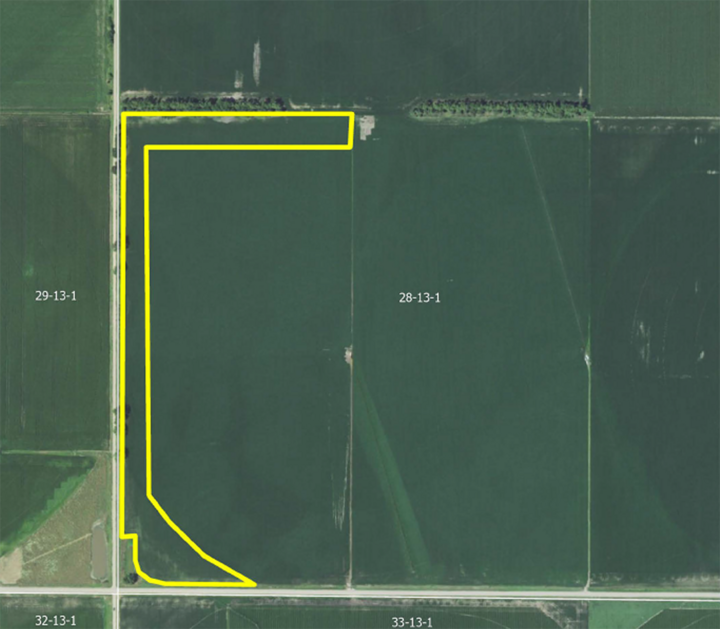
The remainder of the field was planted to seed corn and managed by the grower using conventional agricultural practices typical of the region. Five insecticide applications were made in seed corn area during the growing season (Table 1). No insecticide treatment was applied in the cover crop area.
| Insecticide | Rate (oz/acre) | Date |
|---|---|---|
| Hero EC (zeta-cypermethrin + bifenthrin) | 4.0 | July 23 |
| Hero EC (zeta-cypermethrin + bifenthrin) | 4.0 | July 28 |
| Hero EC (zeta-cypermethrin + bifenthrin) | 4.0 | Aug. 1 |
| Elevest SC (bifenthrin + chlorantraniliprole) | 7.0 | Aug. 5 |
| Brigade 2EC (bifenthrin) | 6.4 | Aug. 7 |
Insect surveys were conducted at three times during the growing season (July 11, July 31 and Aug. 20, 2025) in both the cover crop and seed corn areas. Approximately one acre within each area were surveyed using a meandering walk method with visual observation of insects and the associated host plants, with an active survey duration of 30 minutes per site.
All surveys were conducted between 9:30 am and 5 p.m., under environmental conditions characterized by mean wind speeds of 9.2 mph, mean temperatures of 76.7°F, and cloud cover averaging 69.3%. All insects and plants were identified by direct visual observation or through photographic documentation, using iNaturalist and other reliable taxonomic identification resources.
Methodology: Data Summaries
Data and photos from field surveys were evaluated to confirm the identity of insects to lowest possible taxonomic level.
Data were converted from categorical to numerical data, i.e., a specific count was assigned rather than a range (i.e., <10 = 5, 10-29 = 20, 30-49 = 40, and 50+ = 65) to allow for a numerical summary of the results.
Insects categorized as “undetermined” were excluded from analysis. All insects were also categorized as “beneficial” (pollinators, predators, natural enemies, etc.), “potential pest” (herbivores of crop plants), or “not applicable” based on life history.
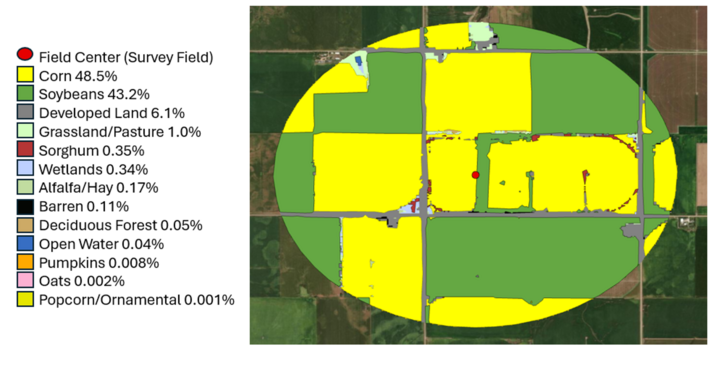
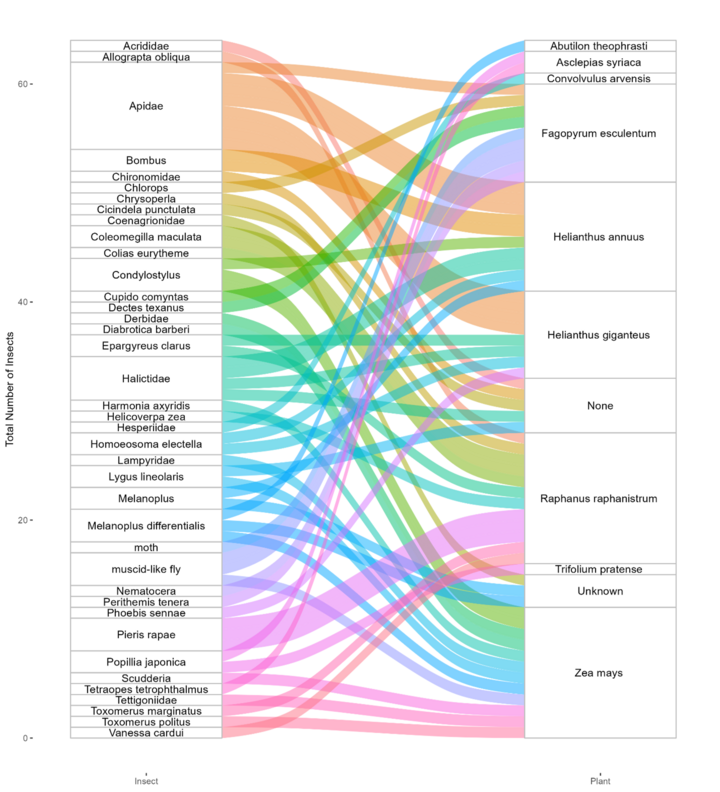
Diversity was considered to be the number of unique morphospecies reported in the surveys. Sampling dates were evaluated to determine whether they could be used as replicates — repeated measurements used for comparison — and run statistical analyses; however, our models did not run with this approach. Therefore, the numerical trends are shown below in Figures 2-5. Data for all surveys was pooled and bipartite alluvial plots — diagrams showing how often insects were observed on specific plants — for insect-plant interactions (how frequent certain insects were found visiting certain plants) were created in R 4.2.2 (Figures 6-7). We also evaluated the habitat composition within a 1.5 km radius around the field location (center of the field). ArcGIS Pro and the 2024 Cropland Data Layer (USDA National Agricultural Statistics Service) were used to categorize land classes and calculated acreages (Figure 8).
Results
Total Insect Abundance
Total insect abundance was generally higher — about 2x higher — in the cover crop surveys compared to the seed corn surveys. Numbers in both locations increased slightly over the course of the summer (Figure 2). While we cannot say that these differences were statistically significant, there was a clear pattern of higher insect numbers observed in the cover crops compared to the seed corn.
Beneficial Insects
Breaking down the abundance into specific categories, beneficial insects were also more abundant in the cover crop surveys compared to the seed corn during all three survey dates (Figure 3). Numbers consistently increased over time in the seed corn but peaked in the cover crop treatment on the July 31 survey date.
Potential Pests
The abundance of potential pests was also higher in the cover crop surveys across all dates with abundance peaking in both sites on the July 31 survey (Figure 4).
Insect Diversity
On the July 11 and Aug. 20 dates, insect diversity (the number of unique morphospecies — visually distinct insect types — reported in the surveys) was higher in the cover crop area, however during the July 30 survey, diversity was slightly higher in the seed corn area — although these numbers are very close (Figure 5).
Insect–Plant Interactions
Surveys conducted in the seed corn treatment documented 29 different taxon — distinct groups of insects — all of which were associated with corn (Zea mays) or no plant (Figure 6). Common names are provided for all scientific names found in the interaction figures (Table 2 and 3).
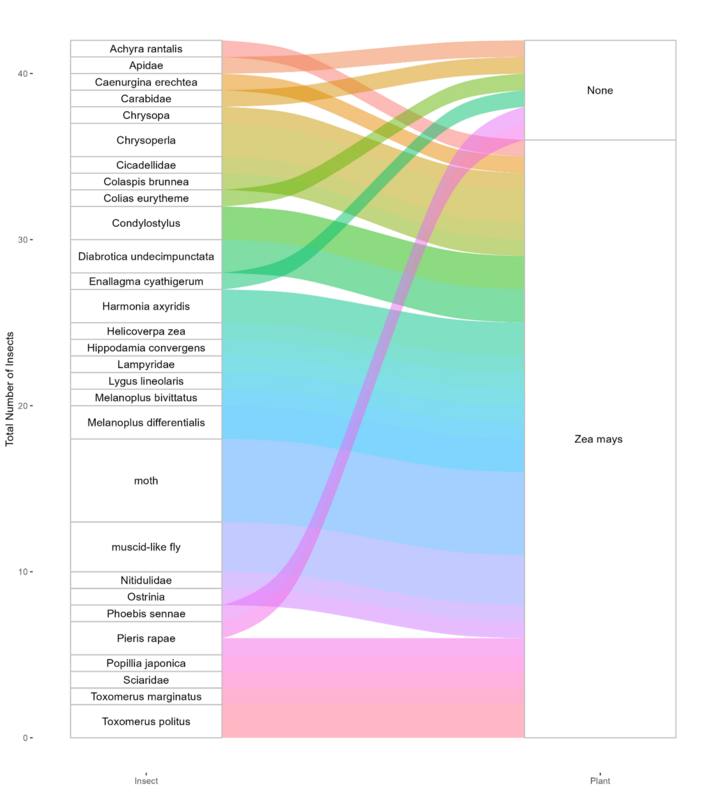
Surveys conducted in the cover crop treatment documented 39 insect taxa and approximately 10 plant species they associated with (Figure 7).
Key to Scientific Names of Insects | ||
Taxon | Common Name | Group |
Achyra rantalis | Garden Webworm Moth | Pest |
Acriddidae | Grasshopper | Pest |
Allograpta obliqua | Oblique Streaktail (Syrphid fly) | Beneficial |
Apidae | Bees | Beneficial |
Bombus | Bumble bee | Beneficial |
Caenurgina erechtea | Forage Looper Moth | Pest |
Carabidae | Ground Beetle | Beneficial |
Chironomidae | Non-biting Midge Flies | - |
Chorops | Grass fly | - |
Chrysopa | Lacewings | Beneficial |
Chrysoperla | Lacewings | Beneficial |
Cicadellidae | Leaf hoppers | Pest |
Cicindela punctulata | Punctured Tiger Beetle | Beneficial |
Coenagrionidae | Damselflies | Beneficial |
Colaspsis brunnea | Grape Colaspis | Pest |
Coleomegilla maculata | Spotted Pink Lady Beetle | Beneficial |
Colias eurytheme | Orange Sulphur | Beneficial |
Condylostylus | Longlegged flies | Beneficial |
Cupido comyntas | Eastern Tailed-Blue | Beneficial |
Dectes texanus | Dectes Soybean Stem Borer | Pest |
Derbidae | Plant Hopper | Pest |
Diabrotica barberi | Northern Corn Rootworm | Pest |
Diabrotica undecimpunctata | Southern Corn Rootworm (Spotted Cucumber Beetle) | Pest |
Enallagma cyanthigerum | Common Blue Damselfly | Beneficial |
Epargyreus clarus | Silver Spotted Skipper | Beneficial |
Halictidae | Sweat Bees | Beneficial |
Harmonia axyridis | Asian Lady Beetle | Beneficial |
Helicoverpa zea | Corn Earworm Moth | Pest |
Hesperiidae | Skippers (Butterflies) | Beneficial |
Hippodamia convergens | Convergent Lady Beetle | Beneficial |
Homoeosoma electella | American Sunflower Moth | Pest |
Lampyridae | Fireflies | Beneficial |
Lygus lineolaris | North American Tarnished Plant Bug | Pest |
Melanoplus | Grasshopper | Pest |
Melanoplus bivittatus | Two-striped Grasshopper | Pest |
Melanoplus differentialis | Differential Grasshopper | Pest |
Moth | Moths (various families) | Pest |
Muscid-like Flies | Flies (various families) | - |
Nematocera | Nematocera | - |
Nitidulidae | Sap Beetles | Pest |
Ostrinia | Moth | Pest |
Perithemis tenera | Eastern Amberwing | Beneficial |
Phoebis sennae | Cloudless Sulphur | Beneficial |
Pieris rapae | Cabbage White | Beneficial |
Popillia japonica | Japanese Beetle | Pest |
Sciaridae | Fungus Gnats | Pest |
Scudderia | Bush Katydids | Pest |
Tetraopes tetrophthalmus | Red Milkweed Beetle | Pest |
Tettigoniidae | Katydids | Pest |
Toxomerus marginatus | Margined Calligrapher | Beneficial |
Toxomerus politus | Maize Calligrapher | Beneficial |
Vanessa cardui | Painted Lady | Beneficial |
Key to Scientific Names of Plants | |
Scientific Name | Common Name |
Abutilon Theophrasti | Velvetleaf |
Asclepias syriaca | Common Milkweed |
Convolvulus arvensis | Bindweed |
Fagopyrum esculentum | Buckwheat |
Helianthus annuus | Sunflower |
Helianthus giganteus | Sunflower |
Raphanus raphanistrum | Radish |
Trifolium pratense | Red Clover |
Zea mays | Corn |
Based on 2025 Cropland Data Layer (USDA NASS), corn and soybean make up 48.5% and 43.2%, respectively, of the acres within a 1.5 km area around the surveyed field. Approximately 6% is developed land, 1.0% grassland/pasture, and the remaining categories make up less than 1% each (Figure 8).