Soybean gall midge, Dectes stem borer, and several plant diseases continue to be some of the most important threats to soybean production in Nebraska. With support from the Nebraska Soybean Board, our team provided in-season updates on what we were seeing in farmers’ fields and research sites across the east and south-central portion of the state.
If you want to learn more about what we saw during the season, you can view the July 2, Aug. 7 and Sept. 5 reports, which summarize larval counts, plant injury and disease presence at each of the nine sites.
One important note: the management tactics used in this study were not designed to be practical or economical for farmers. Instead, the goal was to create clear comparisons so we could better estimate how much yield these pests (and diseases) can cause when they show up. This article focuses on the late-season larval counts, how often these pests occurred together, and the yields observed at the study sites.
Highlights
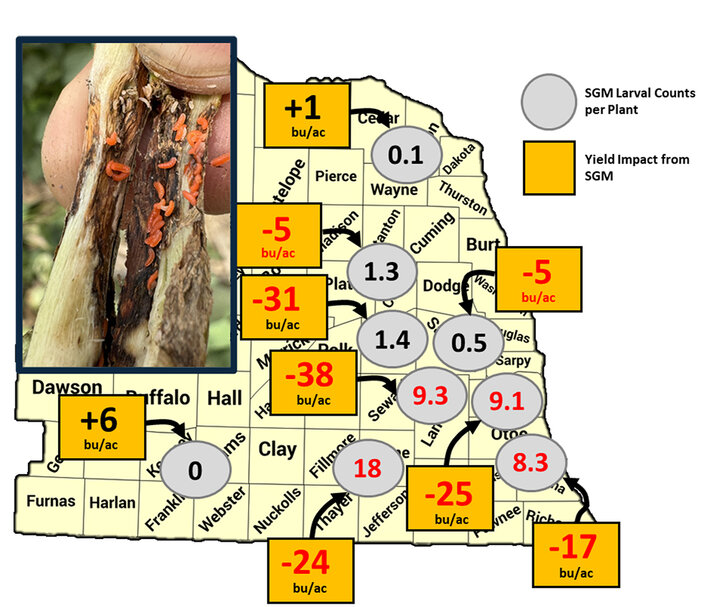
- Yield losses were observed at seven of nine sites from soybean gall midge, with losses ranging from 5 to 38 bu/acre (Figure 1).
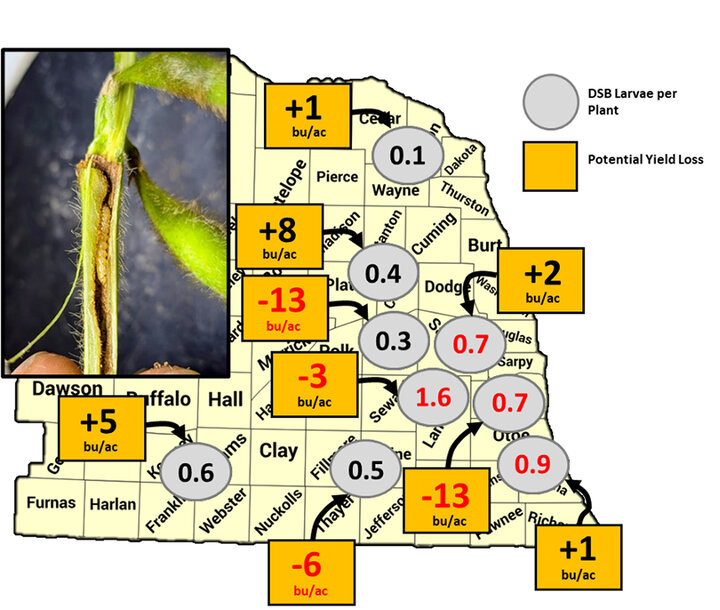
- Dectes stem borer yield losses occurred at four of the nine sites, with losses ranging from 3 to 13 bu/acre (Figure 2).
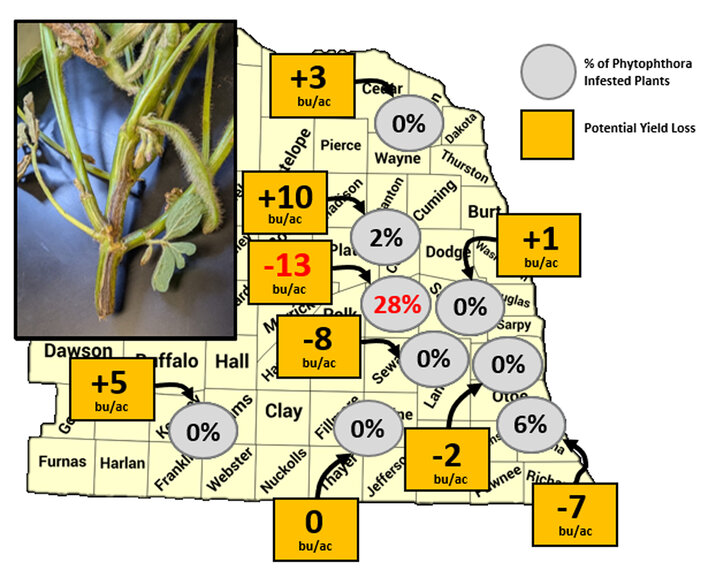
- Phytophthora impacted yield only at four of the nine sites with a 2 to 13 bu/acre impact (Figure 3).
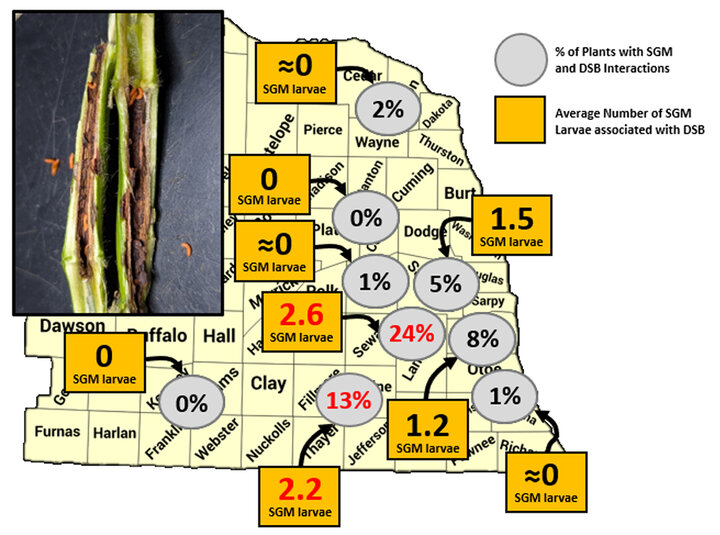
- Co-occurrence of soybean gall midge and Dectes stem borer occurred at seven of the sites; however, the frequency of this occurrence was low (1-24% of plants).
Soybean Gall Midge (SGM)
- With the exception of the Wahoo site (1.4 larvae/plant), larval count on plants reflected yield losses from SGM (Figure 1).
- Yield losses ranged from 17-38 bu/ac on high-pressure sites.
- The lack of yield differences in Adams County and northeast Nebraska indicates that the use of hilling to control SGM had little effect on yield in the absence of infestation.
Dectes Stem Borer (DSB)
- Only two sites showed significant yield losses from DSB (Figure 2), and yield losses did not correspond to DSB larval counts.
- Lodging from DSB was not frequent at any of the sites within days of harvest.
- If lodging had occurred, yield losses would increase due to the inability to harvest the fallen plants.
Plant Diseases
- Phytophthora was the prevalent disease with the greatest frequency of symptomatic plants near Wahoo (Figure 3).
- Hilled treatments for SGM management reduce the incidence of Phytophthora symptoms in plants.
- This reduction in Phytophthora from hilling may be the reason that a yield increase was observed for SGM (Figure 1) at the Wahoo site.
Soybean Gall Midge and Dectes Stem Borer Interactions
- Interactions were found at all sites, except for Colfax and Adams counties.
- Lancaster and Saline counties had the highest rate of interactions between pests.
- The top two counties with interactions were also the same sites with high soybean gall midge larval counts.
Want to Join a 2026 Tailgate Discussion?
We plan to repeat this study in 2026. In 2025, we also held “tailgate” discussions at several locations so farmers could discuss these pests and talk through realistic management options.
If you’d like to attend a tailgate near you in 2026, contact Justin McMechan and you’ll be notified when a discussion is scheduled in your area.