Key Takeaways
Nebraska's soybean 50% planting progress has been advancing over the past 45 years.
Every day that 50% of soybean planting progress moves early in Nebraska has translated into 0.5-0.9 bushels per acre of yield increase.
In 2025, the 50% soybean planting progress reached May 8 — about nine days earlier than 2024 — and the overall yield gain was about 8 bu/ac relative to 2024.
Nebraska’s corn 50% planting progress date has been relatively stable since 1995. Still, there is a trend that the earlier the corn is planted, the earlier the soybean is planted.
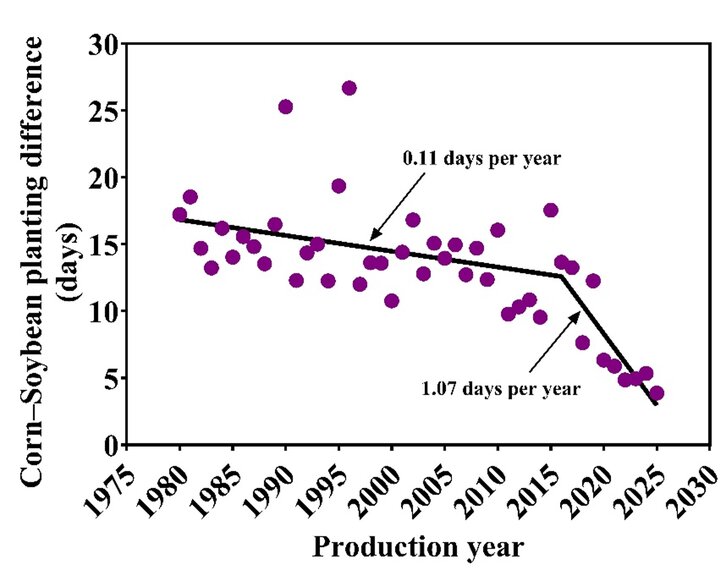
The difference in days between 50% planting progress of corn and soybean has been drastically reduced in the last 10 years, from 13 to only four days in 2025.
2026 Planting Progress
As of April 27, the USDA planting progress for Nebraska indicates that 26% of corn and 19% of soybean fields have already been planted. These numbers indicate excellent planting progress for this year. Soybean planting is 8% ahead of 2025 and 11% ahead of the five-year average for this time of year. For corn, planting progress is 7% ahead of 2025 and 10% ahead of the five-year average. Kudos to Nebraska farmers where the ground is fit for planting early!
Historical 50% Planting Progress (1980-2025)
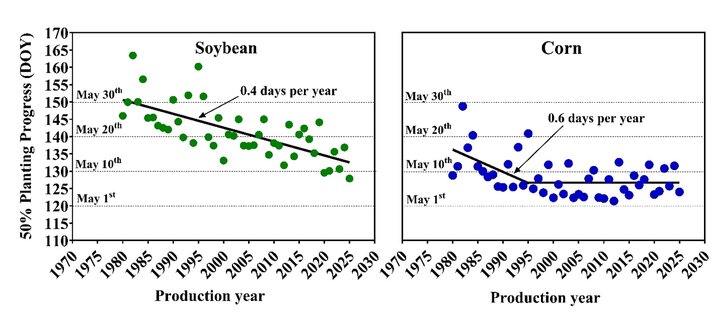
Soybean planting progress has shifted significantly over time, with the 50% planting date advancing at a rate of 0.4 days per year (Figure 1). Back in the early 1980s, Nebraska 50% planting progress was achieved in late May or even early June. The 45-year (1980–2025) historical mean for soybean planting is May 20. Today, 50% soybean planting progress typically occurs in early May. Indeed, in 2025, soybean reached the earliest 50% planting progress in history on May 8.
Despite 35-plus years of improved equipment, faster planters and better hybrids, the collective date by which half of Nebraska's corn acres are planted has remained within the first week of May. Nebraska farmers can use May 5 as a benchmark for 50% planting progress (Figure 1).
It is important to note these trends are statewide and other factors — including changes in farming technology, seeds and crop management — have also evolved over time.
Earlier Planting Pays Back
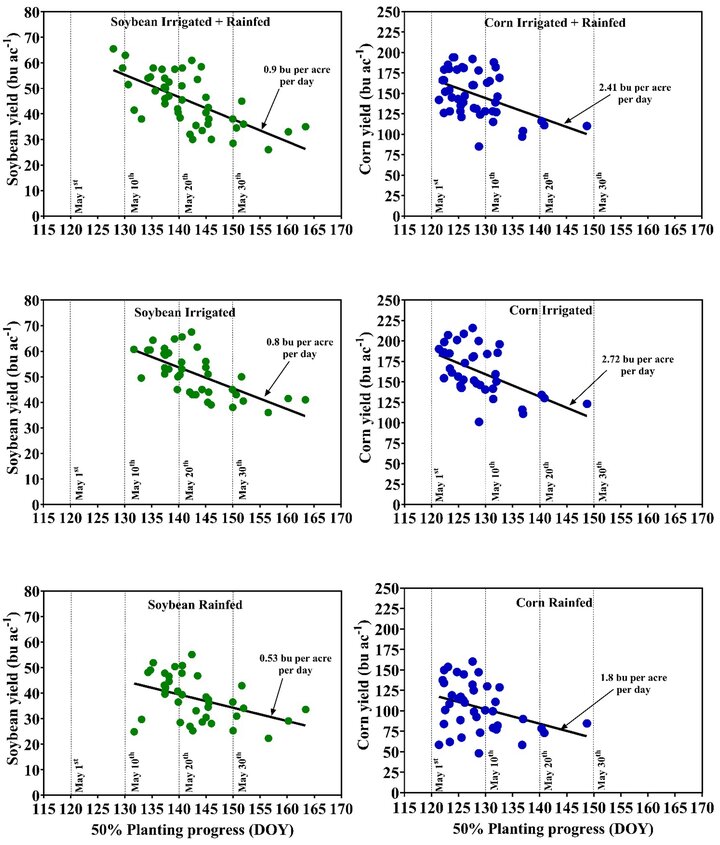
For soybean, the trend shows that each day of earlier planting increases the soybean yield by 0.9 bu/ac across all environments, with irrigated fields gaining 0.8 bu/ac per day and rainfed fields gaining 0.5 bu/ac per day. The highest state-level soybean yield of 65.5 bu/ac was observed with the earliest 50% planting progress of May 8 in 2025 (Figure 2). As a result, yield was highest for early planted soybean and we found a penalty of 1/8 to 1/4 bu/ac per day of delay in planting for MG2.1 and MG3.0 varieties, respectively (Figure 4). But this penalty can be as high as 5/8 bu/ac per day of delay as reported by previous Nebraska studies (see articles: "Early Bird Gets the Worm: Benefits of Early Soybean Planting" and "Why Soybean Planting Date Matters").
For corn, each day earlier in reaching 50% planting progress has been associated with a 2.41 bu/ac increase in statewide yield. Under irrigation, the corn yield benefit increases to 2.72 bu/ac per day, and in rainfed corn, planting early has been related to an increase in corn yield by 1.77 bu/ac per day (Figure 2). However, when looking at the 50% corn planting progress between May 2 and 12 in Nebraska, planting a few days earlier or later within that window does not significantly change the corn yield. This does not mean corn planting time is unimportant. It means Nebraska producers have already done a good job of getting corn planted within its optimal planting window.
In general, the earlier farmers finish planting corn, the earlier the soybean get planted. As this trend continues year by year, it is important for farmers to consider planting soybeans first, then corn.
How Many Days Separate 50% Planting Progress for Corn and Soybean?
Historically, corn has been planted first, and then soybean followed two to three full weeks later, with an average of 15 days from 1980 to 2016. The difference in 50% planting progress for corn and soybean has decreased to an average of 6.4 days between 2017 and 2025. In 2025, that difference hit a record low of just four days between 50% corn planting and soybean planting progress. (Figure 3). Farmers across Nebraska are increasingly planting corn and soybean at nearly the same time. Indeed, some farmers are planting soybean before corn to maximize both corn and soybean yields.
Corn and Soybean Now Compete for the Same Planting Window
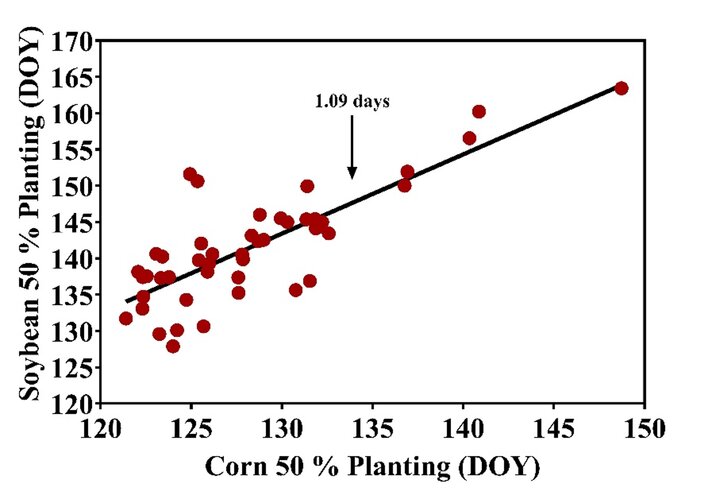
This coming‑together of corn and soybean plantings is not just something we see when we average many years. We also see it when we look at each year by itself. From 1980–2025, years with later corn planting also saw later soybean planting. The one-day delay in corn planting pushes soybean planting behind by 1.1 days (Figure 4). That means when wet or cold springs slow corn planting, soybean usually fall even further behind.
Planting Considerations
Early planting is not a free lunch, but the return on investment in inputs is usually high. Early planted crops must be carefully managed, including appropriate soil temperature and moisture for planting. Seed-applied fungicide packages for any seed going into cold, wet soils need to be considered. Planter adjustments are important when rapid changes in weather occur, such as starting planting in dry conditions and receiving rains like this week. If planting progress continues at this pace, Nebraska could set a new record for early corn and soybean planting this year.