Key Takeaways
Drought-Stressed Alfalfa Can Still Be Managed: Producers may choose to hay, graze or leave drought-stunted alfalfa depending on yield potential, livestock needs and input costs.
Short Stands May Not Be Worth Cutting: Harvesting very short alfalfa stands may not justify fuel and labor costs, especially if yields are below one-half ton per acre.
Grazing Requires Careful Management: Drought-stressed alfalfa can often be grazed safely with proper precautions to reduce bloat risk and protect plant health.
Protect Alfalfa Crowns and Regrowth: Maintaining adequate stubble height and removing cattle after rainfall can help preserve stand health and reduce damage.
Leaving Fields Untouched May Be Best: If haying or grazing are not practical, allowing drought-stressed stands to remain dormant may be the most economical option until rainfall returns.
With the continuing drought, pastures, alfalfa and small grains are taking a turn for the worst. When drought stress causes dryland alfalfa stands to stop growing, what should you do?
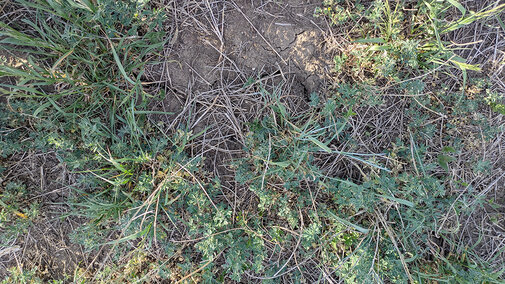
Many producers have dryland alfalfa fields with plants six to 12 inches tall and getting increasingly purple/yellow/gray by the day. When faced with short alfalfa stands, what should we do — hay it, shred it, graze it or just leave it?
First, the good news: While it stays dry, you can do almost anything you feel like doing and you aren't likely to hurt your alfalfa as long as crown buds aren’t damaged. The bad news is that if it stays dry, you can't do anything good for it either.
As your alfalfa continues to sit dormant, it will slowly lose feed value and tonnage due to continued maturation, as well as leaf loss from insect feeding, diseases and simple old age. We’ve been seeing increased alfalfa weevil pressure recently, so keeping an eye out for significant pests is important and may impact your decision-making. If you choose to harvest as-is, you probably need a yield of at least one-half ton per acre to justify the fuel, labor and other expenses involved with harvesting hay.
From a plant health standpoint though, the University of Wisconsin recommends not harvesting if the flowering stand is under 10 inches in height. Because quality of drought-stressed stands declines less rapidly with maturity than normal, allowing plants to reach 100% bloom can improve recovery after a harvest does occur.
Grazing might be relatively cheap in terms of out-of-pocket costs if you already have portable electric fence and don't need to spend much money to transport cattle or water. Plus, dry, bloomed-out alfalfa has a pretty low risk for bloat — not foolproof, but good grazing management practices should enable you to graze safely.
Many of the questions we’re receiving are from growers whose alfalfa isn’t much more than 6 inches tall and in the late bud stage. We’d recommend waiting until it starts blooming if possible and add some free choice hay to help with any potential bloat. Rotational strip grazing can improve forage use efficiency while limiting daily intake to help manage bloat risk. A back fence or rotation to limit animals going back to graze any regrowth is also important to protect alfalfa plant health and lower bloat risk. Shoot to maintain a stubble height of at least 4 inches. To estimate a stocking rate, a rough rule of thumb is 50 grazing days for every 1,000 lb. of animal per 1 ton of alfalfa produced.
Also, never turn hungry animals out on alfalfa, even if it’s drought stressed and relatively dry. It’s best to feed hay prior to turning out on the alfalfa and watch animals closely the first few days of grazing. If possible, limit turning animals onto fresh alfalfa that has dew on it or is being rained on until later in the morning or until plants are dried off. Additional moisture can increase bloat risk.
Finally, be prepared to pull animals if precipitation returns and plants begin growing. This is twofold in purpose. First, it protects alfalfa crowns from hoof damage that may occur in soft soils following rain. Second, growth that resumes following rain is going to be very high in quality and digestibility, drastically increasing bloat risk if it becomes a major part of the diet. Additional information can be found in the Nebraska Extension NebGuide G2030, “Grazing Alfalfa”.
If you can't graze and can't justify cutting hay, it's probably best to just leave it alone. Shredding or haying will give you a cleaner, higher quality hay once your alfalfa does receive enough rain for regrowth. While removing dormant growth may slightly speed regrowth, plants will recover following sufficient rainfall even without cutting. In most cases, it's not worth the cost and time involved to shred, clip or harvest low-yielding hay.
Pick the option best for you and pray for rain.
Resources
- Undersander, Dan. “Effect of Drought on Alfalfa and Managing for the Next Growing Season.” Crops and Soils Extension, University of Wisconsin–Madison, cropsandsoils.extension.wisc.edu/articles/effect-of-drought-on-alfalfa-and-managing-for-the-next-growing-season/.
- Franzen, D. “Producers Have Options for Managing Drought-Affected Alfalfa.” North Dakota State University Extension, 14 June 2021, www.ag.ndsu.edu/news/newsreleases/2021/june-14-2021/producers-have-options-for-managing-drought-affected-alfalfa.
- Volesky, Jerry and Bruce Anderson. “Grazing Alfalfa”. UNL NebGuide, UNL,
https://extensionpubs.unl.edu/publication/g2030/na/html/view.