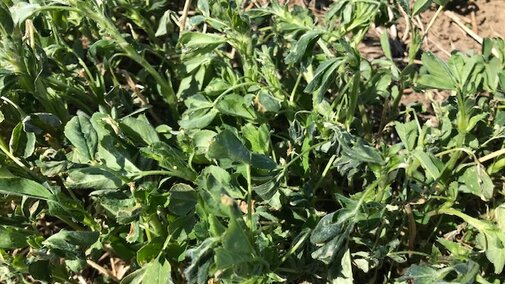
Spring freezes can make alfalfa fields look rough in a hurry. Wilted leaves, blackened tops, water-soaked tissue, and stems that bend or lay flat can all show up shortly after a cold night. When that happens, it is natural to wonder whether the stand is lost, whether first cutting will be delayed, or whether the field needs to be clipped off to start over.
In most cases, the first recommendation is simple: wait.
Alfalfa often looks worse immediately after a freeze than it will a few days later. Nebraska Extension guidance recommends giving plants a few freeze-free days before making management decisions. That waiting period allows producers to see whether damaged stems continue growing, whether new buds begin to develop, and whether the growing point is still alive.1
Temperature Does Not Tell the Whole Story
The temperature recorded at the house, pickup, or nearest weather station is only part of the picture. The temperature at plant level in the alfalfa canopy may be different, especially in low-lying areas where cold air settles. Low spots can be several degrees colder and may stay cold longer than higher areas of the field.
Injury also depends on how long temperatures stayed low, how much spring growth was present, soil temperature, wind, residue cover, and field topography. Short alfalfa is generally at lower risk than taller alfalfa because less plant tissue is exposed. Nebraska Extension notes that alfalfa around 3 inches tall is much less likely to see serious injury than alfalfa with 12 inches of growth.
As a general guide, light frost may only burn exposed leaves, while a moderate freeze (mid-20s for several hours) can kill the upper stem and terminal buds. In these cases, plants often regrow from lower axillary buds on the stem or from crown buds, which will delay growth and push back first cutting. A hard freeze (low 20s or below for several hours) can kill leaves, buds, and stem tissue, often causing plants to fall flat. Even then, established plants can regrow from crown buds, although first cutting will be delayed and yield reduced.
These temperature ranges can be useful for setting expectations, but should not replace a field assessment. The better question is: what are the plants doing several days after the freeze?
Field condition going into the freeze also matters. Drought-stressed alfalfa may be less able to tolerate or recover from cold injury than plants growing with adequate moisture. Moist soils also hold and release heat better than dry soils, which can help buffer temperature swings near the soil surface and lower canopy. With dry soils, freeze injury may show up more severely, especially in borderline freeze events. This does not change the assessment process, but it does mean dry fields may need extra time before making a decision on recovery and cutting.
Look at the Growing Point
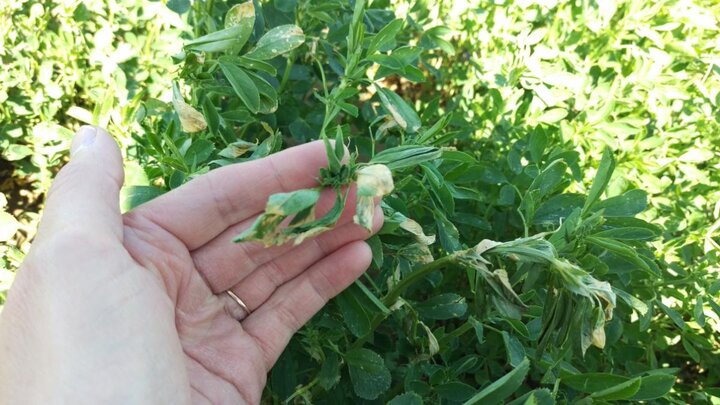
Leaf burn by itself does not tell the whole story. The most important part of the plant to check is the growing point, also called the terminal bud or apical meristem. This is the tight cluster of young leaves at the top of the stem where new leaves, stems and branches form.
If that growing point remains green and firm, the stem may continue growing even if the surrounding leaves are wilted or blackened. In that case, the field may look ugly but still have good recovery potential.
If the growing point is brown, limp or dead, growth from that stem stops. The plant then has to recover from lower stem buds or new crown shoots. This slows recovery and may delay first cutting or reduce yield.
When scouting, walk several parts of the field. Check low areas, hilltops, sheltered areas and field edges separately. Damage may be patchy, and one area of the field may not represent the whole stand.
Established Stands: Usually Leave Them Alone
For established stands with light to moderate leaf burn, the best option is usually to leave the field alone and let it grow. If terminal buds are still green and alive two to three days after the freeze, there is no need to do anything. Established alfalfa will generally outgrow light freeze injury, although drought-stressed fields may recover more slowly.
Cutting, grazing or shredding just because the field looks bad can create more stress than benefit. If there is not enough growth to justify harvest, clipping the field is usually not worth the cost or plant stress. Wisconsin Extension guidance notes that mowing short, frost-damaged alfalfa often does not improve recovery because plants can regrow from lower axillary buds.
In some cases, removing damaged top growth may help. If plants are taller, badly damaged and remain flat on the ground after several warm days, removing that material may help new shoots grow with less shading. If that is done, avoid cutting low enough to remove new crown shoots. Those new shoots are the recovery mechanism and damaging them can set the stand back further.
Fields Seeded Last Fall Need Extra Caution
Fall-seeded alfalfa can be tricky. These fields are not true spring seedings, but they also are not as resilient as older established stands. They should generally be assessed more like an established stand by looking at growing points, lower buds and new crown shoots.
The difference is plant reserve. Fall-seeded stands usually have smaller crowns and root systems than older stands. They have less stored energy to support regrowth after stress. Because of that, cutting, grazing or shredding too soon may be more damaging than it would be in an older stand.
For these fields, give plants extra time before making a final decision. If growing points are alive and new growth is starting, patience is usually the best management choice. If the field looks poor after several days of warm weather, then begin evaluating stand density and recovery potential.
Spring Seedings Are Different
True spring seedings should be evaluated separately from established stands. Small seedlings are close to the soil surface, which can provide some protection, but survival depends on whether the seedling still has living leaves and a living growing point.
If at least one set of leaves escapes frost damage, seedling survival is likely. However, if all leaves are damaged and seedlings become discolored, survival is less likely and stand counts become important. Seedlings that lose all their leaves and look discolored likely will not grow back. Stands thinner than about 15 plants per square foot may need additional evaluation and possible reseeding.
Seedling stage also matters. Newly-seeded alfalfa can be relatively frost tolerant early, but seedlings become more vulnerable once they move beyond the second trifoliate stage. Companion crops can help new alfalfa seedlings survive under closer or longer periods of exposure by creating a canopy trapping warmer air below it.
Management Options After Injury
After several freeze-free days, decisions should be based on plant response.
- If leaf edges are burned but growing points are green, do nothing and harvest at the normal stage.
- If growing points are damaged but stems remain upright, give the stand time to regrow from lower buds or crown shoots. First cutting may be delayed.
- If plants are lodged, flat and not recovering after several warm days, removing damaged top growth may help, but only if there is enough growth to justify the operation and cutting height can protect new crown shoots.
- If a spring seeding has widespread seedling death, take stand counts before deciding whether to reseed or interseed.
- If the field was already drought-stressed, avoid cutting, grazing or shredding too soon. Give plants time to show whether surviving buds are actively regrowing before adding another stress.
The main point is to avoid managing by appearance alone. A field can look bad and still recover. On the other hand, a field with dead growing points may need time to restart growth even if crowns remain alive.
Final Thoughts
Spring freeze damage in alfalfa is frustrating because it creates a field that looks worse before the answer is clear. The best decision usually comes after a few days of patience.
Do not judge too early and do not cut just because the field looks bad. Look at the growing points, watch for new buds, and base the decision on plant recovery.
Most freeze-damaged alfalfa will recover, but first cutting may be delayed and yield may be reduced. The goal is to protect the stand, avoid unnecessary stress, and support regrowth for the rest of the season.
Resources
- Nebraska CropWatch. "Assessing Alfalfa Post-freeze." University of Nebraska–Lincoln.
https://cropwatch.unl.edu/assessing-alfalfa-post-freeze/ - Nebraska CropWatch. "Assessing Freeze Damage to Alfalfa." University of Nebraska–Lincoln, 2019.
https://cropwatch.unl.edu/2019/assessing-freeze-damage-alfalfa/ - Nebraska CropWatch. "Freeze Damage to Alfalfa." University of Nebraska–Lincoln, 2020.
https://cropwatch.unl.edu/2020/freeze-damage-alfalfa/ - University of Wisconsin Extension. "Frost Damage to Alfalfa."
https://fyi.extension.wisc.edu/forage/frost-damage-to-alfalfa/ - South Dakota State University Extension. "Effects of Late Spring Frost on Alfalfa."
https://extension.sdstate.edu/effects-late-spring-frost-alfalfa