With forecasted runoff for the North Platte Project well below average, concerns about irrigation water supply took center stage at the 2026 Yonts Water Conference.
Nearly 300 attendees filled the auditorium beyond capacity April 8 at the Panhandle Research Extension and Education Center in Scottsbluff. The crowd of Nebraska and Wyoming ag producers and irrigation stakeholders in the North Platte River Valley gathered to receive updates on snowpack/runoff conditions, reservoir carryover, tunnel replacement progress, and resources and options from the USDA Risk Management Agency.
The U.S. Bureau of Reclamation (USBOR) provided estimates for the snowpack/runoff for the North Platte River Basin. The 2026 forecasted runoff/inflow for the North Platte Project (Pathfinder and Guernsey) is approximately 550,000 acre-feet — well below the average of around 891,000 acre-feet.
This total includes 340,000 acre-feet of water ownership/carryover in both reservoirs. The 550,000 acre-feet of water is split between the Pathfinder Irrigation District, Goshen Irrigation District, and the Gering-Fort Laramie Irrigation District. The amounts each district will receive will depend on the final estimated forecasts from the USBOR and on each district's carryover amounts. Other irrigation districts in the North Platte River Valley may have some storage water carryover at Glendo and rely on natural-flow water rights.
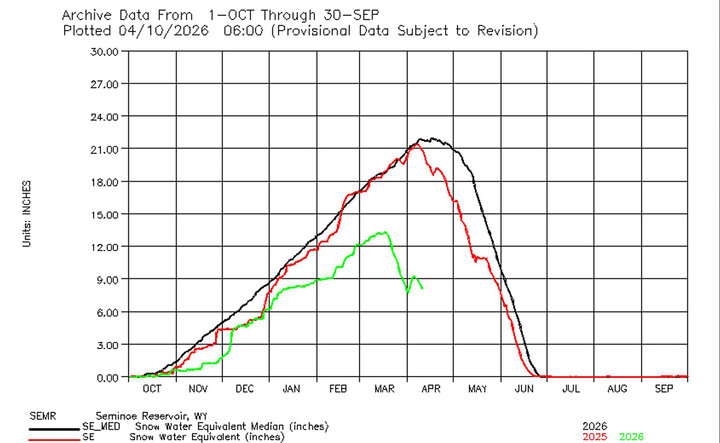
The snowpack/runoff started approximately 30 days earlier than normal, with snow water equivalent about 9-10 inches less than normal. The North Platte River Basin snowpack is at 39% of normal at this time.
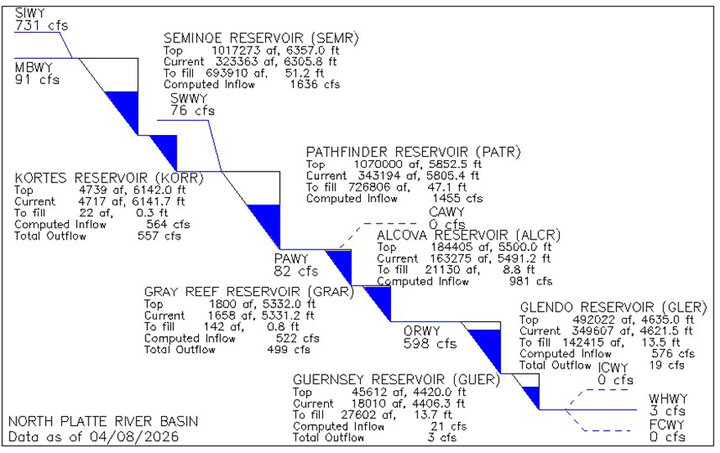
Currently, Pathfinder Reservoir, 343,194 acre-feet full, and Seminoe Reservoir, 323,363 acre-feet full, are each 32% full. Glendo Reservoir, 349,607 acre-feet, is 71% full. Water allocations are expected for the 2026 growing season. The trigger amount for a forecasted allocation is a supply of less than 1,100,000 acre-feet.
“We have received interest from irrigation districts regarding water loans,” said George Finnegan, USBOR Wyoming Office water scheduler. “We have approached Wyoming Seminoe/Alcova reservoirs (Kendrick Project), and they have agreed to work with us.”
Irrigation districts would need to notify the USBOR of their interest in a water loan, the requested water quantity, and the payment terms. The water loan cannot exceed 100,000 acre-feet. The loan request must be approved by the Casper-Alcova Irrigation District, the state of Wyoming, and the USBOR, and a NEPA review must be completed.
The cost has yet to be determined, there is no carryover, and the loaned water must be repaid to the Casper-Alcova Irrigation District prior to the 2027 water delivery.
Given these conditions, the potential exists for senior water-right holders to place a call on the river, with details to be worked out between Nebraska and Wyoming. If implemented, a call would require junior water users to reduce or stop diversions to meet senior water rights.
The timing and duration of water deliveries will be determined by the irrigation districts at a later date.
Many of the producers at the meeting are also waiting on the irrigation districts’ decisions. Given the current drought, producers are hard-pressed to make agronomic decisions for their operations.
“Well, it sure looks like we're probably in a situation where we're not going to be allowed a lot of irrigation water,” said Doug Harimon, Scottsbluff farmer and crop adjuster. “It is getting pretty dire. The problem is that our ground is so dry right now that getting the crop started is an issue. Even if we have 40 to 50 days of water, we will need it just to get the crop up.”
In addition to water supply updates, Nebraska Extension personnel provided information on nitrogen application rates, amounts, and timing to help reduce over-application of this nutrient and avoid groundwater contamination.
Conference presenters also highlighted research on deficit irrigation for area crops to producers, should there be limited water supplies this growing season. Field-specific evapotranspiration (ET) for sugar beets, corn and dry beans for irrigation water application management can be found on ACREE, a free mobile irrigation-scheduling app that does not require soil moisture sensors.
Representatives from the Gering-Fort Laramie Irrigation District and HDR Engineering provided an update on the replacement of Tunnel No. 2 on the Goshen/Gering-Fort Laramie Irrigation District’s main line canal. New entrances and exits for the tunnel are being constructed for the digger shield to commence tunnel replacement starting in the fall of 2026. The two affected irrigation districts have secured the funds to replace both tunnels, thanks to efforts by Nebraska and Wyoming legislative representatives and the USBOR.
The USDA Risk Management Agency (RMA) representatives outlined assistance programs and answered questions about potential scenarios producers may encounter with the expected water shortage in the North Platte River valley. Local weather forecaster Don Day provided the spring and early summer weather outlook.
A special thanks to the Goshen Irrigation District, Gering-Fort Laramie Irrigation District, Pathfinder Irrigation District, and Farmers Irrigation District board members and staff who helped make this conference possible.
The Yonts Water Conference was livestreamed to accommodate producers, landowners and related agricultural entities. Click here to view the conference recording.