Key Takeaways
Rhizobium inoculant increased yield and marginal net return in years with lower soil nitrogen levels
No yield or economic benefit was observed when soil nitrogen approached recommended levels
Inoculants may offer a low-cost option to support production when soil N is limited
Results suggest inoculants are most effective under suboptimal nitrogen conditions
A three-year on-farm research study evaluated Exceed® Superior Legume Inoculant on dry edible bean production. The active ingredient is Rhizobium leguminorsarum biovar phaseoli. The dry inoculant was thoroughly blended with seed in the planter box before planting at a rate of 82.5 oz per 1,500 lb of seed.
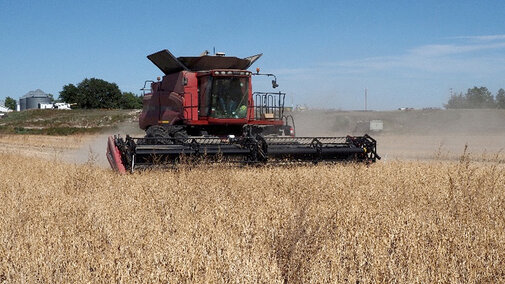
The dry edible beans were direct harvested (Figure 1) each year in September or October. Samples from each plot were analyzed for bean quality parameters. Harvest loss estimates were determined by taking counts in one-square-foot frames randomly chosen in the harvested area. The studies were planted in a replicated and randomized plot design with four replications.
Total available N (nitrate nitrogen) in the top 36 inches of soil was 55 lbs., 73 lbs. and 94 lbs. respectively for years 2023, 2024 and 2025. The final year was very near 100 lbs. of N, which is the recommendation for top dry edible bean yields by the University of Nebraska.
In situations where adequate N is available, rhizobia inoculants will not perform at optimal levels according to the manufacturer and a benefit may not be realized.
The data in Table 1 indicate that in 2023 and 2024, when soil N levels were below optimal, the inoculant resulted in a significant yield increase and a marginal net return advantage. In 2025, when N levels were near optimal, there was no significant yield or net return benefit from using the inoculant. With high N prices and concerns about leaching into groundwater, low-cost Rhizobium inoculants may offer a practical option in dry edible bean production.
Growers do not typically use an inoculant with dry edible beans in areas where beans are regularly grown. However, if soil N levels are significantly below recommended rates, an inoculant may provide value as growers look to reduce N fertilizer use.
- The 2025 marginal net return was based on $16.80/bu dry beans, with Exceed® Superior Legume Inoculant at $2.20/ac.
- The 2024 marginal net return was based on $24.60/bu dry beans with Exceed® Superior Legume Inoculant at $2.14/ac.
- The 2023 marginal net return was based on $22.80/bu dry beans with Exceed® Superior Legume Inoculant at $1.79/ac.
2023 Growing Season Rattler Pinto Bean | 2024 Growing Season Eiger Great Northern Bean | 2025 Growing Season Rattler Pinto Bean | ||||
| Treatment | Yield (bu/ac) | Marginal Net Return ($/ac) | Yield (bu/ac) | Marginal Net Return ($/ac) | Yield (bu/ac) | Marginal Net Return ($/ac) |
| No Inoculant | 40 b | 912.56 b | 35.2 b | 866.03 b | 49.5 a | 770.07 a |
| Inoculant | 42 a | 960.70 a | 38.1 a | 935.87 a | 49.5 a | 771.85 a |
| Available N | 55 lbs. N/ac | 73 lbs. N/ac | 94 lbs. N/ac | |||
* Values with the same letter are not significantly different at a 90% confidence level.
† Bushels per acre corrected to 14% moisture.