Adult soybean gall midge emergence has begun in parts of Nebraska and Iowa, signaling the start of the period when producers in high-risk areas should begin monitoring soybean growth stages and local emergence activity. Recent detections in Otoe and Lancaster counties indicate the pest is becoming active, though emergence remains limited across the region.
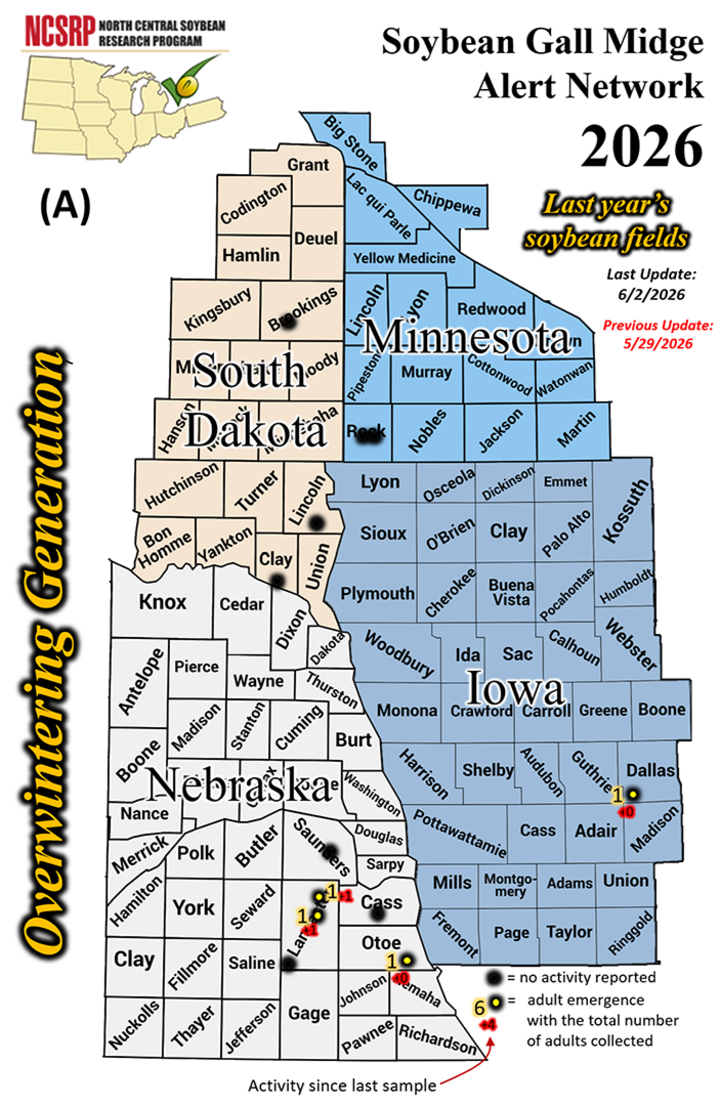
The first emergence of soybean gall midge for the season was observed in Otoe County on May 29, near Talmage, Nebraska (Figure 1). In Iowa, the first detection of an adult gall midge occurred on June 2 near Dexter in Dallas County. Continued adult emergence was detected at two monitoring locations in northern Lancaster County, with a single adult collected at each site on June 1. No adult emergence has been detected in South Dakota or Minnesota at this time.
As a reminder, depending on the planting date in May, some soybean fields may not yet be at the V2 growth stage when stem fissures begin to form, and plants become susceptible to soybean gall midge infestation. See the Soybean Gall Midge Alert Network for soybean staging information and examples of stem fissures.
Before considering an insecticide application, use the following checklist:
- Is the field adjacent to a soybean field with soybean gall midge pressure from the previous year?
- Are soybean plants at the V2 growth stage?
- Is adult emergence occurring in your area based on the emergence map and alerts?
If an application is being considered, use a product containing a pyrethroid active ingredient. Applications only need to target the current year’s soybean field edge, generally within the first 60–100 feet of the field adjacent to soybean with plant injury observed in the previous year. However, efficacy of foliar insecticide for soybean gall midge has been inconsistent across locations and years.
We will continue to provide emergence updates and monitor soybean growth stages in high-risk areas as emergence continues. Join the Soybean Gall Midge Alert Network to get the latest information on management, as well as how and when to scout fields for larvae.