Looking Back at 2025
As the new year begins, it is important to look back at pasture and forage production conditions to understand what to focus on for the coming year. Stick around and I'll reflect on forage and pasture production conditions in 2025.
In May, near the beginning of the growing season, about 70% of the range and pasture acres across much of Nebraska were in poor to fair condition. This was likely due to lingering drought effects from 2024, which extended into 2025. Like 2023 and 2024, managing forage and pasture production during drought was also the story for at least the first half of 2025.
In a few areas, alfalfa production was good and, in some cases, above average. The challenge was to find a window harvest with several consecutive days of dry weather. This was also the case for much of the prairie hay, much of which had lower than expected forage quality.
Late summer brought more widespread precipitation, which allowed some pasture recovery across much of Nebraska. The mid-December drought monitor showed abnormally dry to moderate drought conditions continuing in the Nebraska Panhandle and eastern one-third of the state. The southern tier of counties, along with a swath through the central Nebraska Sandhills were reported to be near normal.
Thankfully, many areas ended the year in better shape than they started. For 2026, it will be important to focus on early-season management practices for range and pastures, especially in eastern Nebraska and the Nebraska Panhandle.
Pasture and Livestock Management Using Drones
Producers face a variety of challenges when managing livestock herds and the forage crops grown to feed them. In many ways, the implementation of technology can help to streamline the management process and improve operation efficiency and productivity. An important and increasingly popular example of this technology is drones.
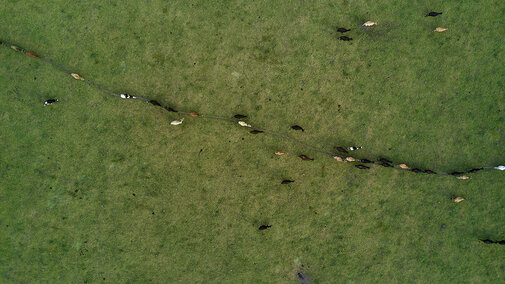
Drone technology can be utilized for a wide variety of tasks and can help save time and reduce costs. For example, drones with high resolution cameras have been used to determine forage utilization by cattle across entire pastures, saving time by reducing the need for ground-based pasture inspections. Recent studies have also shown that drones can be used to estimate and monitor forage crop biomass and scout for insects and disease.
For livestock management in particular, drones can be an invaluable tool. They can be used to inspect herds, find wayward animals, check for estrus, monitor during calving season, check water sources, and even herd livestock. It’s important to note that after a short period of acclimation, cattle tend to adapt well to the sound of a drone.
A major downside to drones is the startup costs. A good imaging drone will cost anywhere from $500-$5,000 and to legally fly a drone for agricultural purposes, a Part 107 license must be obtained by passing an FAA exam, which costs $175.
Please note that additional requirements must be met in order to apply pesticides with a drone.