Key Takeaways
Reduced pollen production: Heat over 95°F depresses pollen production.
Reduced pollen viability: Prolonged periods of heat can reduce pollen production and viability.
Delayed pollen shed: High humidity, without a drop in humidity during the day, can delay pollination or prevent pollen from leaving anther sacs.
Yield loss potential: When soil moisture is sufficient, one day of 95–98°F has little or no impact on yields. After four consecutive days, there can be a 1% loss in yield for each day above that temperature. Greater yield loss potential occurs after the fifth or sixth day.
The effects of heat on corn pollination depend on several factors, including the duration and timing of high temperatures, nighttime temperatures, humidity and available soil moisture. Understanding how these conditions affect the pollination process can help growers assess potential impacts on kernel set and yield.
Background
Corn was originally a tropical grass from the high-elevation areas of central Mexico, about 7,400 feet above sea level — 2,000 feet higher than Denver. Today, corn still prefers conditions typical of that area — warm daytime temperatures and cool nights. Areas that consistently produce high corn yields share some significant characteristics. These areas — including central Chile and the west slope of Colorado — are usually very bright and clear, with high light intensity and cool nights.
Corn maximizes its growth rate at 86°F. Days with temperatures hotter than that cause stress. In the high-yield areas, cool night temperatures — at or below 50°F — reduce respiration rates and preserve plant sugars, which can be used for growth or reproduction, or stored for yield. These are optimum conditions for corn and, interestingly, are fairly typical for areas around central Mexico, where corn is native.
Corn is a C4 photosynthesis plant, making it extremely efficient at capturing light and fixing CO2 into sugars. One drawback of this system is that, with high daytime temperatures, the efficiency of photosynthesis decreases, so the plant makes less sugar to use or store. High nighttime temperatures increase the respiration rate of the plant, causing it to use up sugars that otherwise could be available for growth and development. This results in the plant making less sugar while also using more than it would during cooler temperatures.
In years when high daytime and nighttime temperatures coincide with the peak pollination period, we can expect problems. Continual heat exposure before and during pollination worsens the response.
When soil moisture is sufficient, one day of 95–98°F has little or no impact on yields. However, after the fourth consecutive day, there tends to be a 1% loss in yield for each day above that temperature. After the fifth or sixth day, there tends to be even greater potential for yield loss.
While it is difficult to make yield loss predictions from heat and drought stress in any year, the stress does add up and takes a toll on the crop.
Humidity Impacts
The high humidity, which helps reduce crop water demand, also increases the thermal mass of the air and provides extra stored heat and insulation at night.
Corn pollen is produced within the anthers, the pollen-producing structures of the tassel. The plant releases new anthers each morning, starting near the top of the tassel on the first day of pollen shed and proceeding downward over several days. The process of releasing pollen from the anthers is called "dehiscence." Dehiscence is triggered by the drop in humidity as the temperature rises. However, when it is extremely humid and the humidity falls very little, dehiscence may be delayed until late in the day or not occur at all. If there is a breeze while the humidity is still very high, the anthers may fall to the ground before pollen is released. If the temperature rises too high before pollen dehiscence occurs, the pollen may have reduced viability when it is shed.
Producers experienced in hand pollination in corn will often see this happen — there will be anthers in a "tassel bag," but little pollen. The typical solution to this is to wait a couple of hours until higher temperatures reduce humidity. Impacts on silk fertilization — particularly in open-pollinated situations — may occur when pollen is never released from the anthers.
Problems with Silking
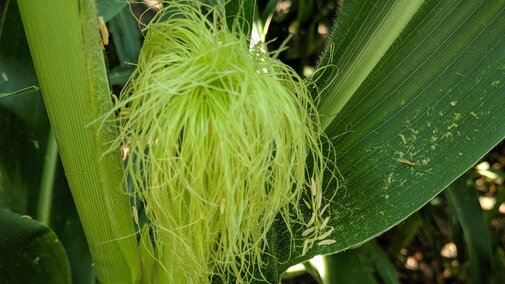
Heat — especially combined with lack of water — has devastating effects on silking. If plants are slow to silk, the bulk of the pollen may already be shed and gone. Modern hybrids have vastly improved anthesis-silk interval (ASI, the time between mid-pollen shed and mid-silk) with silks emerging with or before pollen shed. Regardless, we see seed set problems in some irrigated and non-irrigated fields because of "nick" problems between pollen and silking. One challenge occurs if silks emerge and become too long prior to pollen shed, or when tighter top leaves wrap the tassel, preventing as much pollen shed. Older silks can become less receptive to pollen with age, particularly if they dry out under higher temperatures, drought stress and low relative humidity.
Even in some stressed areas within irrigated fields (extreme sandy spots, hardpans or compaction areas where water isn't absorbed and held, and some "wet spots"), we have observed stress-induced slow silking and resulting seed set issues. Historically, this has been the most important problem leading to yield reduction, particularly in stressful years. Once silks begin to desiccate, they lose the capacity for pollen tube growth and fertilization.
Even with adequate moisture and timely silking, heat alone can desiccate silks so that they become non-receptive to pollen. This is a bigger problem when humidity is low. Even with dew points in the 70s, when temperatures reach the upper 90s or exceed 100°F, heat can still desiccate silks and reduce silk fertility.
Heat also affects pollen production and viability. First, heat over 95°F depresses pollen production. Continuous heat over several days before and during pollen shed results in only a fraction of normal pollen being formed, likely because of reduced sugar availability. In addition, heat reduces the period of pollen viability to a couple of hours (or less). While there is normally a surplus of pollen, heat can reduce the fertility and amount available for fertilization of silks. It's been shown that prolonged exposure to high temperatures reduced the volume of pollen shed and dramatically reduced its viability.
For each kernel of grain to be produced, one silk needs to be fertilized by one pollen grain.
Kernel Set Reduced
The net result of these conditions can be reduced kernel set. Effects will likely vary depending on field conditions, hybrid and the timing and duration of heat stress. Problems are typically most noticeable in stressed areas of fields, hybrids that are slow to silk and non-irrigated fields. However, modern drought-tolerant hybrids have notably improved silking/pollen shed synchrony. Under ideal growing conditions, some hybrids actually silk ahead of pollen shed, which can result in reduced kernel set under some environmental conditions — particularly if they tend to have tighter top leaves wrapping the tassel.
Some hybrids may be impacted more than others. The timing of extreme heat, silking versus pollen shed for particular hybrids and other factors are involved. Just a day or two difference in flowering, planting or other factors can make a substantial difference in kernel set. Stress during pollination and silking could result in shorter ears, increased tip back and fewer kernels per ear. All of these contribute to less yield potential.
Resources
For more information, see these articles in Crop Science, a journal of the Crop Science Society of America. Full-text articles are available by subscription; abstracts are available online.