Editor's note: This article is the first in a three-part series explaining how Endangered Species Act (ESA) requirements affect pesticide applications in Nebraska. Part 1 introduces the regulatory background and outlines current label requirements for products such as Enlist One® and Liberty® ULTRA. Part 2 focuses on runoff and erosion mitigation strategies. Part 3 addresses ecological spray drift mitigation (Dec. 17).
What Applicators Should Know
ESA label requirements now apply to several commonly used herbicides in Nebraska, including Enlist One®, Enlist Duo® and Liberty® ULTRA.
These ESA directions are enforceable and are designed to prevent off-target movement that could affect federally listed species and their habitats.
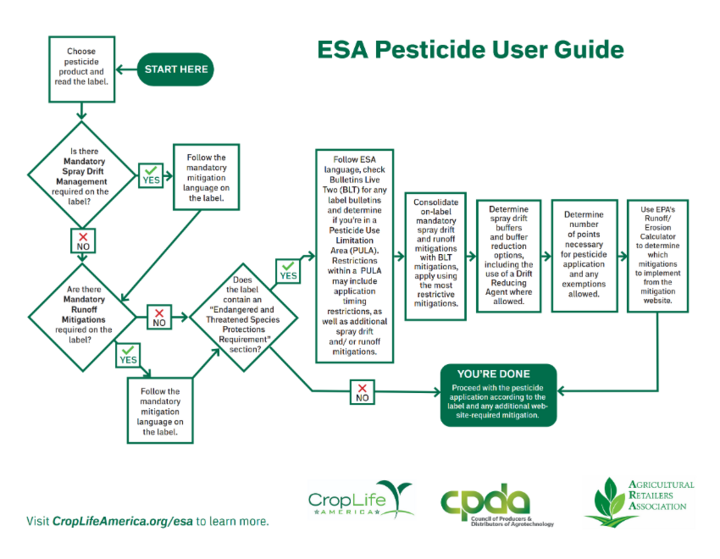
When labels reference ESA mitigation, BLT checks are required to determine whether a field falls within a PULA and to follow the bulletin for the month of application.
In tank mixes, the most restrictive requirements apply, including spray drift, runoff and erosion mitigation from either product.
Mitigation measures use point systems and adjustable buffers: runoff/erosion practices must meet minimum points, and spray drift credits can reduce required buffer distances, sometimes to 0 feet.
More products may receive ESA language as registrations are updated, so applicators should expect evolving compliance requirements.
As federal pesticide regulations continue to evolve, growers and applicators (both private and commercial) in Nebraska are facing changes that affect how, when and where certain products can be applied, along with additional documentation requirements.
The Endangered Species Act (ESA), enacted in the early 1970s, is a federal law designed to protect endangered and threatened species (collectively referred to as ‘listed species’), as well as the habitats critical to their survival. Administered by the U.S. Fish and Wildlife Service and National Marine Fisheries Service, the ESA ensures that actions taken by federal agencies, including the registration of pesticide products, do not negatively impact listed species or their habitats. Therefore, all pesticide products entering the market or undergoing registration review may be required to include ESA-specific language, which adds new compliance responsibilities for applicators.
The U.S. Environmental Protection Agency (EPA) evaluates the potential impact of each pesticide individually and, if necessary for the intended application, may require mitigation for runoff, erosion and ecological spray drift through ecological mitigation label statements. Whenever referenced by a pesticide label, applicators must consult Bulletins Live! Two (BLT) to determine whether their fields fall within a Pesticide Use Limitation Area (PULA) and follow specified restrictions. Only federally listed species are addressed by the BLT statements; however, the ecological mitigation portion should help reduce exposures to all non-target species, including state-listed threatened and endangered species.
Currently in Nebraska, several herbicide products — including Enlist One®, Enlist Duo®, and Liberty® ULTRA and/or associated alternate brand names — carry ESA compliance requirements on their labels. For the Enlist® product line, which is labeled for use in Enlist® soybean and corn systems, these requirements apply specifically to the 2,4-D choline salt component of the products. While Enlist Duo® — a premix of 2,4-D and glyphosate — is also subject to ESA restrictions, this article focuses on Enlist One®, as the same ESA compliance rules apply to both.
Helpful product label resources:
- Enlist One® (manufacturer label)
EPA Reg. No. 62719-695
2,4-D Choline Salt, Corteva Agriscience LLC. - Liberty® ULTRA (manufacturer label and supplemental label — expires March 19, 2027)
EPA Reg. No. 7969-500
Glufosinate-P-Ammonium, BASF Corporation.
Both Enlist One® and Liberty® ULTRA include ESA compliance requirements on their labels. These are not optional; they are enforceable use directions intended to protect federally listed species and their habitats (as well as other non-target plants and animals) from potential exposure due to off-target pesticide movement.
Before applying any listed product with ESA compliance requirements, applicators must consult the EPA BLT map web tool (a step-by-step tutorial for accessing and using the BLT) to determine whether any application restrictions apply to the time and location of their planned application. A valid bulletin must be obtained within six months of the application, and the version specific to the planned month of application must be followed.
When applying multiple pesticide products as a tank mix, applicators must follow the most restrictive label requirements, including any ecological spray drift, runoff and erosion mitigation measures associated with either product. This added responsibility means users must verify compliance before making applications, particularly when operating in areas designated as vulnerable under the EPA’s mitigation framework.
The runoff and erosion mitigation measures will have a point system: each mitigation measure carries a point value, and to comply, the points for each site must meet the points for the product. Ecological spray drift mitigation will have a starting distance for a buffer or setback. Each mitigation measure allowed by the label will reduce that starting distance by a specific percentage. Depending on the level of mitigation implemented, buffer distances may be reduced — and in some cases to 0 feet — if the cumulative mitigation credits meet or exceed the required threshold.
To help navigate these changes, we have published additional articles that highlight two key mitigation strategies from the ESA Mitigation Menu that are relevant for most field operations using Enlist One® or Liberty® Ultra:
- Ecological Mitigation: Runoff and Erosion Measures, Part 2
- Ecological Mitigation: Spray Drift Measures, Part 3
Understanding and implementing these practices helps maintain compliance, reduce off-target movement, protect threatened and endangered species, their habitats, and other non-target plants and animals, and ensures continued access to essential row-crop protection products. This list is not exhaustive, and as new products are introduced or re-evaluated during registration renewal, they may include updated ESA-specific language and additional mitigation requirements.
Helpful Resources:
- Nebraska Department of Agriculture Supplemental Materials
- CropLife America’s Adapting to ESA: Mitigation Overview Instructional Video
- CropLife America’s Adapting to ESA: Bulletins Live! Two Instructional Video
To the best of our knowledge, and based on the available information, this summary accurately reflects the current regulations, mitigation requirements, and product label guidance as of Nov. 17, 2025. Regulations and label instructions continue to evolve, and amendments will be made as necessary to incorporate the most up-to-date information as it becomes available. Tools such as hardcopy worksheets, spreadsheet calculators, and the Pesticide App for Label Mitigations (PALM) web-app are available to assist applicators in documenting runoff and drift mitigation requirements. However, their applicability depends on the specific directions and limitations provided on each product label.
All referenced materials are cited and provided either as hyperlinks or as supplemental resources for the convenience of end users. These resources have been compiled strictly for educational and informational purposes. No proprietary content is claimed, and all materials remain the property of their respective owners.
Thank you to the Nebraska Corn Board for supporting this series of articles (Project #88-R-2526-10) and to CropLife America for granting permission to repurpose select educational materials.