Key Takeaways
Larger Droplets Improve Accuracy: Sprinkler packages that produced larger droplets were more resistant to wind drift and delivered water more effectively to the target area.
Bubble Plates Reduce Drift: Bubble-style plates performed well under windy conditions, though their smaller wetted diameter increased the potential for ponding and runoff.
Fine Droplets Drift Easily: Fine-droplet sprinkler packages were highly susceptible to wind drift and produced less uniform water distribution during the test.
System Maintenance Matters: Worn pressure regulators and inconsistent operating pressure can reduce irrigation efficiency and alter sprinkler performance.
Sprinkler Selection Requires Balance: Choosing the right sprinkler package depends on wind exposure, soil infiltration rates, application intensity and field management goals.
Efficient irrigation relies on minimizing water losses and maximizing the portion of applied water that reaches the crop root zone. Improving efficiency becomes even more critical in dry years like 2026, when irrigation demand is high, air temperatures are elevated, and relative humidity is low. Under these conditions, every inch of applied water matters, and minimizing losses becomes a priority for optimizing crop productivity and conserving groundwater resources.
Center pivot irrigation systems can experience several types of water losses, including runoff, deep percolation, droplet evaporation and wind drift. Among these, evaporation and wind drift are especially influenced by weather conditions during irrigation events. Both represent portions of pumped water that do not reach the intended target area. Past University of Nebraska-Lincoln (UNL) research has shown that evaporation losses are typically modest — often less than 4% of the applied water, though potentially approaching 10% with sprinklers on top of the pipe under high pressures, creating small droplets.
In contrast, wind drift can lead to larger losses than evaporation by physically moving water droplets away from the intended target area. This not only reduces irrigation efficiency but can also create uneven water distribution across the field. As a result, understanding how sprinkler design influences droplet behavior and drift under windy conditions is essential for improving irrigation performance.
To explore these issues, a field evaluation was conducted recently at the UNL’s South Central Agricultural Laboratory (SCAL) near Clay Center, Nebraska. The objective was to compare three sprinkler configurations under real field conditions, with a focus on wetted diameter, droplet characteristics, and sensitivity to wind.
Field Conditions and Setup
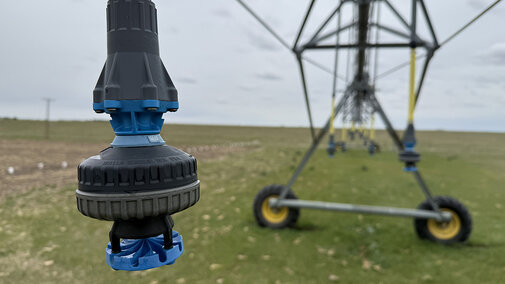
The evaluation was conducted under moderate to strong wind conditions, with sustained winds of 10-15 mph and gusts reaching 20-25 mph, conditions that are not uncommon during the irrigation season in Nebraska. The sprinkler industry offers a wide range of sprinkler packages designed to meet different irrigation goals. In this test, three sprinkler configurations from Nelson Irrigation Corporation were tested:
- Orbitor with blue plate (large droplet design).
- Sprayhead with tan bubble-wide plate (bubbler-style).
- Sprayhead with purple plate (fine droplet design).
All these sprinklers were mounted on drops at 9 feet aboveground. Each configuration was assessed based on observed wetted diameter, droplet size and behavior, and overall performance under windy conditions. In addition, a catch-can test was conducted to evaluate how closely the applied water matched the target depth programmed into the system.

Key Observations
1. Orbitor
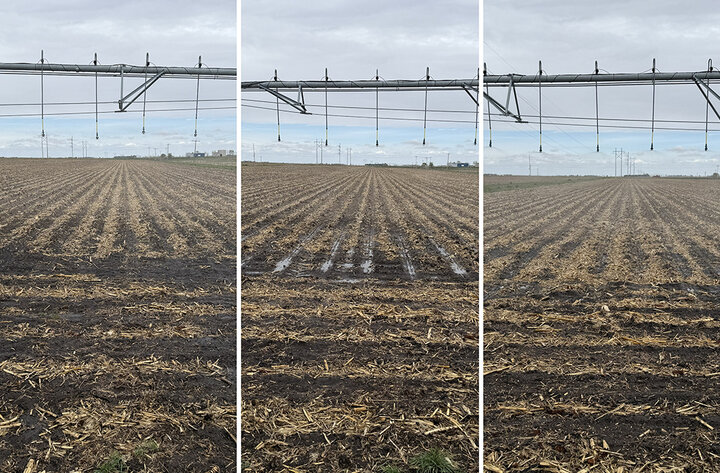
The Orbitor sprinkler performed consistently under windy conditions and maintained a stable water distribution pattern. It also produced a relatively large wetted diameter: approximately 40 feet in the direction of the wind. This broader coverage can help reduce application intensity and thus, the risk of generating surface runoff.
2. Sprayhead with Tan Bubble-Wide Plate
The bubbler configuration produced larger droplets and demonstrated strong resistance to wind drift. The wetted diameter was less than half of Orbitor’s at approximately 18 feet in the direction of the wind. These characteristics make this type of sprinkler particularly effective at delivering water to the intended area when wind is a concern. However, some localized ponding was observed during the test, even at a relatively low application depth of 0.25-inch. This suggests that the higher application intensity associated with a smaller wetted diameter may increase the risk of runoff, particularly in soils with lower infiltration rates or in fields with slope.
3. Sprayhead with Purple Plate
This configuration produced the smallest droplet size and, under calm conditions, would be expected to create a relatively narrow wetted pattern. However, under the windy conditions during the test, performance was significantly compromised. The fine droplets were highly susceptible to wind drift, to the extent that the boundaries of the wetted area could not be clearly identified in the field. This indicates that a substantial portion of the applied water was displaced from the target area. In practical terms, this type of sprinkler configuration may result in reduced irrigation efficiency and non-uniform water distribution when used in windy environments.
Impact of Pressure
Each sprinkler and plate combination is designed to operate within a specific pressure range. When systems operate outside these recommended pressures (either too high or too low), the resulting water distribution can differ significantly from the intended design. For example, higher pressures generally increase wetted diameter and can produce finer droplets, which may improve coverage under calm conditions but also increase susceptibility to wind drift. Conversely, lower pressures tend to reduce wetted diameter and produce larger droplets, which are less prone to drift but result in higher application intensity over a smaller area.
As regulators age or wear, they may no longer maintain consistent outlet pressure, leading to variability in sprinkler performance across the field. This variability can translate into uneven water application, changes in droplet size, and shifts in wetted diameter — all of which affect irrigation efficiency. In windy conditions, inconsistent pressure can further amplify drift losses if some sprinklers begin producing finer droplets than intended. Regular inspection and timely replacement of regulators are critical for maintaining system performance. The industry recommends replacing pressure regulators after 10 years or 10,000 hours of operation.
It is recommended to take a close look at the water pattern from your pivot every two weeks or so during the irrigation season. The pattern should look uniform with more water toward the out end of the pivot. Look for leaks and sprinklers that may be plugged or missing. Also, look for sprinklers that are putting out more water, turning faster, or creating finer droplets which could indicate the pressure regulator has failed. If you find a problem write down the sprinkler location, tower number and number of sprinklers from the tower, so it can be fixed as soon as possible.
What Does This Mean for Producers?
The results of this field test reinforce a key point: sprinkler selection plays a critical role in determining how effectively irrigation water is delivered under windy conditions. In windy conditions, droplet size matters. Sprinklers that produce larger droplets are less likely to be carried away by wind, improving the likelihood that water reaches the soil surface where it is needed.
There is a tradeoff between drift and application intensity. While larger droplets reduce drift, they are often associated with smaller wetted diameters and higher application rates, which may increase the risk of ponding or runoff.
System condition is just as important as sprinkler package selection. Even the best sprinkler package cannot perform as intended if pressure regulators are not functioning properly.
In dry years, when water supplies are limited and crop water demand is high, improving irrigation efficiency becomes even more important. Reducing drift losses and ensuring that applied water reaches the crop root zone can help maximize the value of every irrigation event.
Final Thoughts
There is no single “best” sprinkler configuration for all situations. The optimal choice depends on field conditions, soil characteristics, and management priorities. However, this field evaluation clearly demonstrates that under wind conditions, sprinkler packages that produce larger droplets (such as bubble-style plates) can offer a practical advantage in reducing drift and improving application accuracy.
After all these considerations, we chose to use the bubble-style plate for our research plot applications. The primary reasons were its resistance to wind drift and the smaller wetted diameter. The narrower application pattern is especially beneficial for the narrow-strip, replicated water rate studies conducted at this site. While the Orbitor sprinkler also demonstrated good resistance to wind drift, its wetted diameter was approximately twice as large as the bubble-style plate, making it less suitable for the plot configuration used in this research.
Producers are encouraged to evaluate their current systems, consider how they perform under windy conditions, and work with irrigation professionals to select and maintain sprinkler packages that align with your field conditions and water management goals.