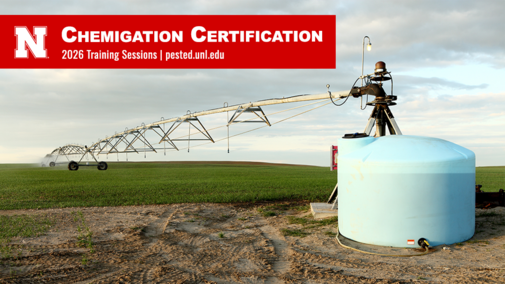
Nebraska Extension will offer face-to-face and online chemigation certification and recertification training for producers in 2026.
Who Needs Chemigation Certification?
Under the Nebraska Chemigation Act (Neb. Rev. Stat. §§ 46-1101 to 46-1148), you need chemigation certification before applying any pesticide or fertilizer to a field through an irrigation system in Nebraska. This is true whether you operate chemigation equipment on your own land or do so on behalf of another landowner.
Not sure if your certification expires in 2026? Look up your certification status.
Landowners must also acquire a permit from their Natural Resources District (NRD) for each chemical injection location they or their operator will use for chemigation.
Face-to-Face Training
Dozens of in-person chemigation training sessions hosted by local extension educators are scheduled to take place throughout the state in the early months of 2026. All training sessions include an opportunity to take the chemigation certification exam. You must pass this exam to become certified or recertified.
Online Training
Online chemigation training for 2026 will become available on Jan. 1 and remain available all year. The online program contains a series of training modules that you must complete to unlock the certification exam. You must pass this exam to become certified or recertified.
Visit our chemigation training page for more information about the online training program.
What Happens After My Training and Exam?
After you have received a passing score on your chemigation exam, the Pesticide Safety Education (PSEP) Office will send the results to the Nebraska Department of Water, Energy and Environment (NDWEE). The NDWEE will then mail your chemigation certification card, which is valid for four years.
There is no fee for chemigation training or the issuance of certification cards. However, chemical injection site permits (obtained through your NRD) do have fees associated with them.
If you have any questions about becoming certified to chemigate, please contact the PSEP Office, 402-472-1632.