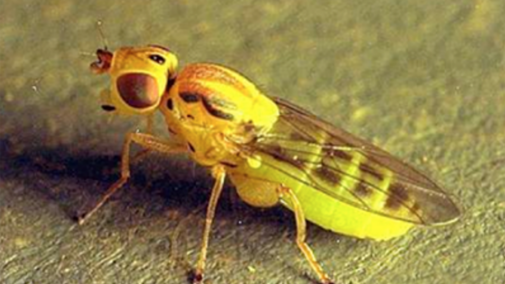
Wheat stem maggot (WSM) damage has been sporadically reported in corn fields that were green planted into wheat or rye cover crops in eastern Nebraska since 2005. This pest causes early-season injury in corn when WSM larvae move from infested, dying cover crops into adjacent corn plants, entering near the first node and tunneling into the cornstalk. The occurrence of this pest has been closely linked to planting corn into living rye or wheat cover crops, commonly referred to as “green planting”.
This year, the Nebraska Extension team is conducting a monitoring effort. Sampling in commercial fields from April 9 to 30, 2026, has detected the presence of adults in the following counties in Nebraska: Dawson, Dixon, Lancaster, Nuckolls, Polk, Platte, Saunders, and York.
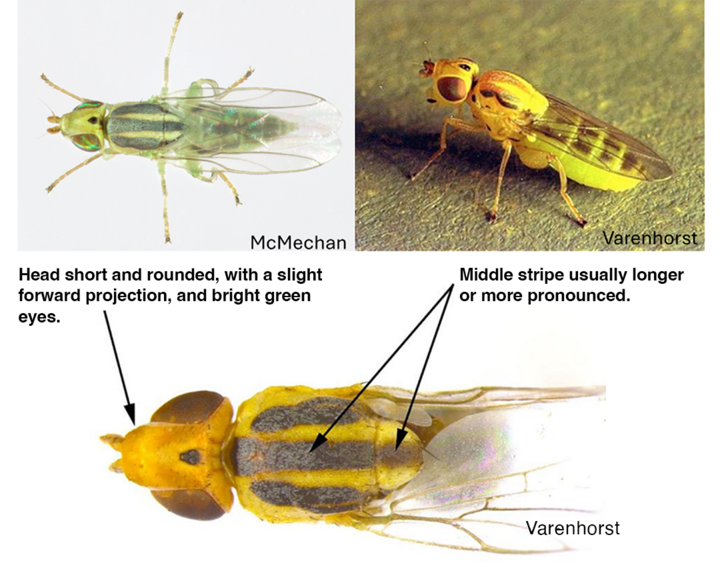
Adult detection is based primarily on the presence of a small fly, about 1/5 inch long, with a yellowish-white to pale yellow body and three distinct black strips. A 10-20x hand lens may be needed (Figure 1).
At this time, there are no validated recommendations for this pest, and we do not recommend tank-mixing an insecticide with an herbicide at cover-crop termination, as the larvae are likely to remain in the cover crop for several days after herbicide application. When the risk of WSM is high, a delayed application timed to larval movement from cover crop to corn is more likely to provide control, but the timing and type of insecticide are not known. Application after larval infestation in corn is unlikely to provide control due to the larval feeding location within the corn plant.
More information about the biology, seasonal occurrence, and damage of this pest is available in “WSM: an emerging pest of cover crop to corn transition systems (Carmona et al. 2019)” and at “2026 Alert System for Wheat Stem Maggot in Cover Crop-to-Corn Systems”.
To receive updates by text or email, or request field monitoring for WSM, by submit the online form to the WSM Monitoring and Alert System.