Introduction
Warm-season cover crops offer a wider range of species selection and greater potential for biomass production than cool-season cover crops. They can be planted after winter wheat, in areas where hail destroyed crops, or as a full-season cover crop. Taking advantage of summer heat and abundant sunlight, they can accumulate impressive amounts of biomass, cover bare ground quickly, suppress weeds, reduce erosion and improve soil health. They can be grazed or cut for hay or silage, providing additional income for producers. Combining species to make a diverse mix — for example, by adding flowering broadleaves — supplies nectar and pollen to pollinators, and the spatial structure of these often tall and dense plantings creates habitat for wildlife.
Species Selection
Sorghum, sorghum-sudangrass hybrids and sudangrass grow rapidly and are tolerant of heat and drought. However, prussic acid found in sorghum, and to a lesser extent in sorghum-sudan and sudangrass, can be harmful for livestock, so use caution when grazing. Millets such as pearl millet and foxtail millet are fast-growing, finer-stemmed grasses that do not contain prussic acid, making them a good choice for grazing. Warm-season legumes such as upright sunnhemp and vining cowpea are excellent N fixers in favorable growing conditions. Buckwheat, a very fast-growing species whose white flowers attract many pollinators, and sunflower, a native plant beneficial to pollinators and with a deep taproot, also contribute to good soil structure.
In trials at UNL, we compared biomass production of different warm-season cover crops with and without irrigation. The results are in Figure 1, management information is in Table 1, pictures of the plants at North Platte are in Figure 2, and pictures of plants in Lincoln are in Figures 3 and 4.
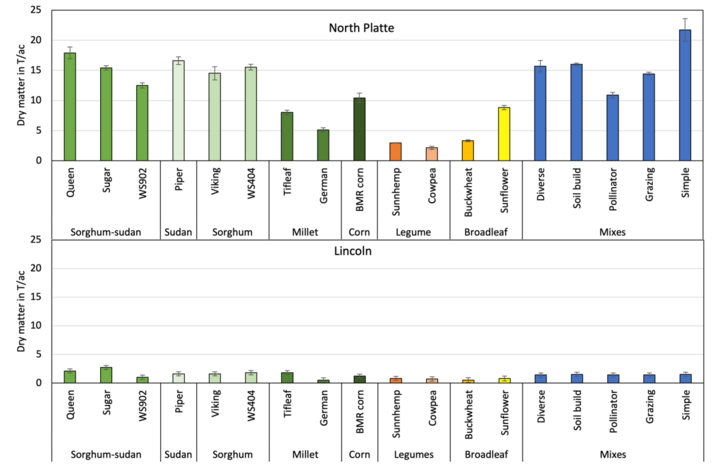
Figure 1. Biomass production (in T/ac of dry matter) of summer cover crops after three months of growth. Top graph shows irrigated cover crops at North Platte, planted 6/20/2022, sampled 9/21/2022. Bottom graph shows rainfed covers at Lincoln, planted 7/12/2022, sampled 10/13/2022.
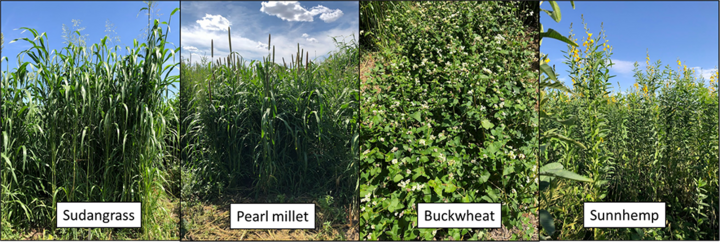
Figure 2. Cover crops at North Platte, seven weeks after planting.
Research Results
At North Platte, where cover crops were irrigated with 18 inches of water*, they produced from two to 22 T/ac of biomass after three month of growth. Sorghum, sudangrass and sorghum-sudan produced the most biomass, up to 18 T/ac. The mixes were also very productive, likely because each mix contained at least one sorghum or sudangrass variety. The millets, BMR corn and sunflower had intermediate biomass of five to 10 T/ac. Legumes and buckwheat were the least productive, with two to three T/ac. The amount of biomass that the up-to-eight feet tall sorghum and sudangrass varieties produced could be challenging to manage, however, so grazing or mowing should be part of the plan. Shorter species such as the millets and broadleaves may be easier to manage. (*The pivot under which our plots were located does not have the capacity for variable rate irrigation. Thus, it received similarly high amounts of water as adjacent experiments with high-yielding corn. In addition, N applied through the pivot to the high-yielding corn was also applied to the cover crops, up to 150 lb N/ac.
At Lincoln, cover crops were planted after winter wheat and not irrigated. They received only two inches of rainfall during their three-month growing period and produced 0.5 to 2.7 T/ac of biomass. Despite their lower biomass, these cover crops still protected the soil, fed pollinating insects and suppressed some weeds.

Figure 3. Sunflowers and bumblebee in Lincoln, 10 weeks after planting.

Figure 4. Highly diverse mix in Lincoln, 10 weeks after planting.
Take Home Points
- Grasses, especially sudangrass, sorghum and sorghum-sudan, can be very productive.
- Mix grasses and broadleaves for greater productivity, diversity and habitat for beneficials.
- Managing the biomass either by grazing or mowing may be necessary in irrigated fields or rainy years.
Definitions for Terms in the Table
- BMR stands for brown mid-rib, varieties with a brown or reddish mid-rib have lower lignin content and are thus considered to be more digestible for livestock.
- Brachytic dwarf varieties have shortened internodes, meaning they are shorter than regular varieties but have the same number of leaves. They are typically more digestible for livestock and less prone to lodging.
| Species | Variety | Variety Information | Seed Rate |
|---|---|---|---|
| Grasses (Poaceae) | |||
| Sorghum-sudan | |||
| Queen Bee BMR | Vigorous, improved palatibility | 25 lb/ac | |
| WS902 brachytic dwarf | High leaf:stem ratio, extremely digestible | 25 lb/ac | |
| Super Sugar | Thin, sweet stems | 25 lb/ac | |
| Sudangrass | Piper | Fine-stemmed, hay and silage | 20 lb/ac |
| Sorghum | |||
| WS404 BMR forage | High yielding, sterile, high sugar content | 15 lb/ac | |
| Viking 401 BMR forage | Medium maturity, sterile, high sugar | 15 lb/ac | |
| Pearl millet | Tifleaf III Hybrid | Leafy, good grazing, drought tolerant | 15 lb/ac |
| Foxtail millet | German | Early maturing, fine stems | 20 lb/ac |
| Corn | BMR grazing corn | Extremely palatable, nutritious | 40 lb/ac |
| Legume family (Fabaceae) | |||
| Sunn hemp | VNS | Upright growth, more biomass | 20 lb/ac |
| Cowpea | Iron and Clay | Less vining than other cowpeas, pollinators | 50 lb/ac |
| Buckwheat family (Polygonaceae) | |||
| Buckwheat | Mancan | Rapid growth | 35 lb/ac |
| Sunflower family (Asteraceae) | |||
| Sunflower | Black Oil Seed | Drought tolerant, pollinators, feeds birds | 10 lb/ac |
| Cover crop mixes (combination of species) | |||
| Simple mix | Sorghum-sudan, sunnhemp, buckwheat, sunflower | Fast growth, high biomass, N fixation, attracts pollinators, few species | 23 lb/ac |
| Grazing mix | Sudangrass, pearl millet, corn, cowpea, cabbage | Fast growth, high biomass, high quality grazing | 33 lb/ac |
| Soil builder mix | Sorghum-sudan, sorghum, sunnhemp, cowpea, cabbage | Fast growth, high biomass, mix of deep taproots and fibrous roots, N fixation | 20 lb/ac |
| Pollinator mix | Sorghum, sunnhemp, cowpea, buckwheat, sunflower | Sorghum provides pollen, broadleaves provide nectar and pollen to insects | 26 lb/ac |
| Highly diverse mix | Sorghum-sudan, sudangrass, sorghum, pearl millet, foxtail millet, corn, sunnhemp, cowpea, buckwheat, sunflower, cabbage | Highly diverse mix (many species of grass, legume, and other broadleaves) | 22 lb/ac |