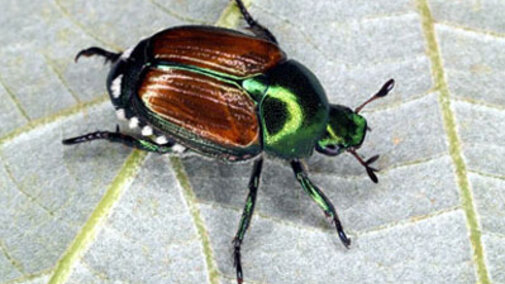
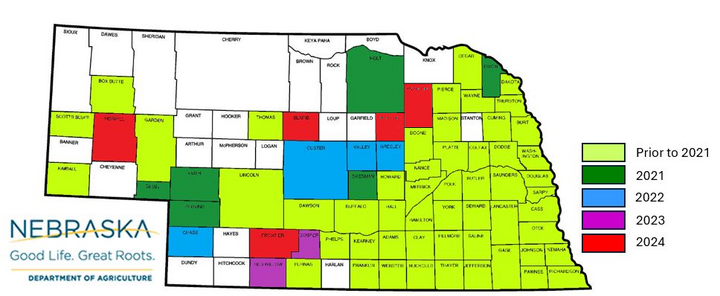
Japanese beetle adults (Figure 1) have emerged in Nebraska. While they are primarily found on landscape trees, shrubs and flowers, as well as horticultural crops, some movement into row crops has recently been observed. Distribution of Japanese beetle distribution has expanded across Nebraska over the last 10 years (Figure 2), and the insects are being observed more frequently in corn and soybean. Although high numbers of beetles along field edges may be concerning, economic thresholds are relatively high. It's important to avoid unnecessary insecticide applications, which can contribute to spider mite outbreaks.
Identification and Biology
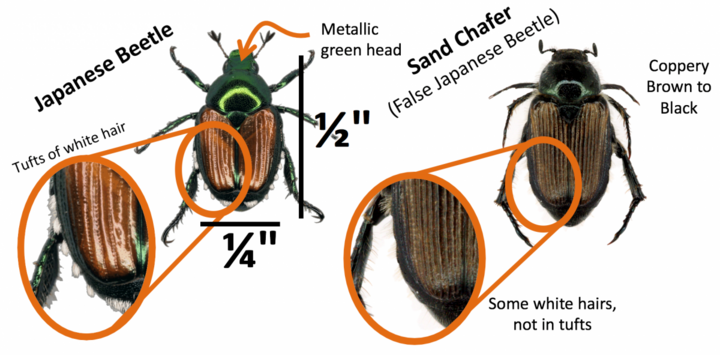
Japanese beetles have one generation per year. They often feed in clusters due to attraction to the female sex pheromone and volatile chemicals produced by damaged plants. Japanese beetle adults are about ½ inch long and have a metallic green head and thorax (Figures 1 and 3). A key characteristic is a series of white tufts of hair on each side of the abdomen.
In some cases, people have mistaken the Japanese beetle for its look-alike, the false Japanese beetle, or sand chafer, Strigoderma arboricola, which is a native Nebraska insect found across most of the state. Sand chafers (Figure 3) are commonly found along the Platte River valley and other river valleys in Nebraska.
False Japanese beetle adults are about the same size as Japanese beetles, but do not have a metallic green head. They may vary in color from coppery brown to black. They may have some white hairs on the side of the abdomen, but they are not organized into tufts of hair (Figure 3).
Sand chafers are often noticed because they have a habit of landing on people and seem to be attracted to light-colored clothing. They have not been reported to cause economic damage to crops as adults, although the immature white grub has been reported to cause damage to potato tubers.
Crop Damage and Scouting
Soybean
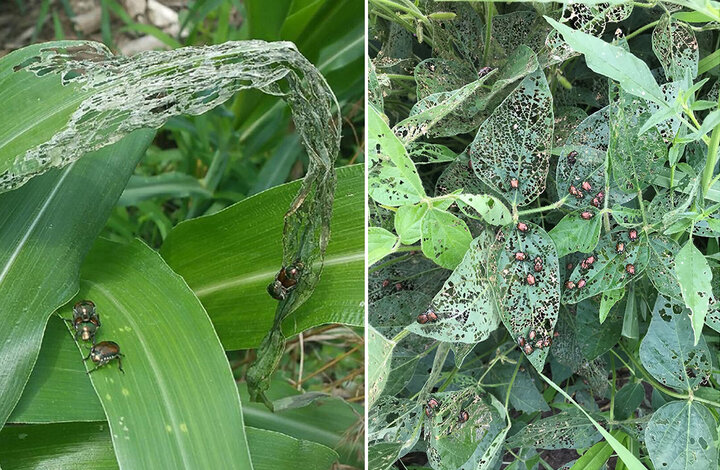
Japanese beetles can contribute to defoliation in soybean, along with a complex of other insects, such as bean leaf beetles, grasshoppers and several caterpillar species. They feed by skeletonizing the leaves, leaving only the leaf veins (Figure 4). They feed primarily in the upper canopy, making the damage very visible.
In soybean, insecticide treatment is recommended when insects are present and damage is expected to exceed 30% defoliation during vegetative stages or 20% during reproductive stages.
For more information, see Nebraska Extension NebGuide G2259, “Managing Soybean Defoliators." Figure 5 describes a process to accurately assess defoliation levels in soybean by sampling from all portions of the canopy. Be aware that Japanese beetle numbers are often highest on field margins, so scout across the whole field before making a treatment decision.

Corn
In corn, Japanese beetles will scrape off the green surface tissue on leaves before silks emerge but prefer silks once they are available (similar to corn rootworm beetles). Japanese beetles feed on corn silks and may interfere with pollination if abundant enough to severely clip silks before pollination.
Be aware that Japanese beetle numbers are often highest on field margins, so scout across the whole field before making a treatment decision. An insecticidal treatment should be considered during the silking period if:
- There are three or more Japanese beetles per ear,
- Silks have been clipped to less than ½ inch, AND
- Pollination is less than 50% complete.
Treatment Recommendations
If populations exceed the economic thresholds described above, a key consideration when selecting an insecticide is the potential to flare spider mite populations.
Products containing the following active ingredients are labeled for use against Japanese beetles in corn:
- Alpha-cypermethrin
- Bifenthrin
- Carbaryl
- Chlorantraniliprole+bifenthrin
- Cyfluthrin
- Deltamethrin
- Gamma-cyhalothrin
- Lambda-cyhalothrin
- Spinosad+gamma-cyhalothrin
- Zeta-cypermethrin
- Zeta-cypermethrin+bifenthrin
Products containing the following active ingredients are labeled for use against Japanese beetles in soybean:
- Alpha-cypermethrin
- Alpha-cypermethrin+acidopyropen
- Beta-cyfluthrin
- Bifenthrin
- Bifenthrin+acetamiprid
- Bifenthrin+imidacloprid
- Chlorantraniliprole
- Chlorantraniliprole+bifenthrin
- Clothianidin
- Cyfluthrin
- Deltamethrin
- Esfenvalerate
- Gamma-cyhalothrin
- Imidacloprid+beta-cyfluthrin
- Imidacloprid+cyfluthrin
- Imidacloprid+lambda-cyhalothrin
For more information, see product labels or the "Insecticides for Field Crops" section from the Nebraska Extension NebGuide EC130, “Guide for Weed, Disease and Insect Management in Nebraska” for rates and restrictions.