This spring, many Nebraska livestock producers facing low forage supplies may be looking for alternative feed sources. Wildfires, drought, slow spring pasture growth, limited cover crop production, and reduced cool-season plant growth are contributing to reduced forage supplies. Given current low wheat prices, some growers are strongly considering harvesting their wheat early for forage and to reduce forage replacement costs.
Wheat forage options can include haying or wheatlage. With haying, it’s best to harvest in the late boot stage before heading, particularly if the wheat is not an awnless variety. With wheatlage, the challenge is that while the need may be pressing, delaying harvest until wheat is at the soft-dough kernel stage may provide greater quantity and quality. Almost all wheat/triticale/rye fields are also ahead of normal growth stage this spring.
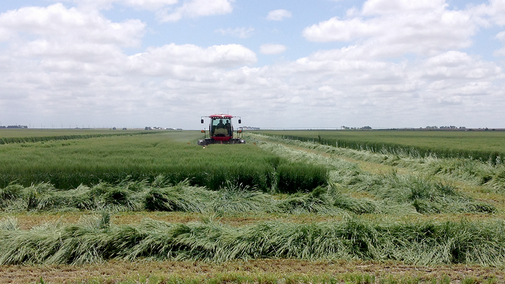
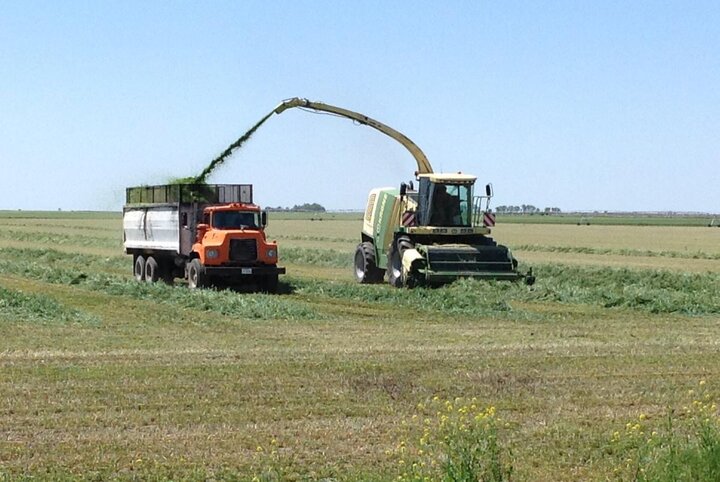
For many south-central Nebraska feedlot/field managers, harvesting wheat for forage in the spring is not new. The most popular wheat forage harvest method used in south-central Nebraska is wheatlage. As the name implies, this method is similar to traditional corn silage harvest. Wheat, oats, triticale or rye fields are first windrowed, then chopped and blown into transport trucks. The trucks then transfer the forage to a bunker storage where heavy implements pack the pile to reduce air content between forage pieces. Tight packing is essential to successful wheatlage production.
Moisture content also may affect harvest timing and is critical to successful ensiling. Moisture content can drop quickly as plants develop from the milk to the late dough stage. If dry soils develop, the soft dough stage may be drier than usual, perhaps even too dry to make good silage. Producers have also experienced too wet of conditions at the soft dough stage. Packing too wet has major impacts on quality. Monitor plant moisture to help plan harvest.
Two common mistakes to watch are the dry matter percentage at chopping and how the forage is packed by keeping the layer thickness down to get a better pack. Based on research with producers, it's suggested to keep the layers no more than six inches (less is better). The following article on packing small grain silage has additional tips.
Research Comparing Wheatlage Harvest Dates
Results from a replicated two-year Nebraska Extension irrigated wheat study north of Bertrand in south-central Nebraska may encourage producers to patiently delay their wheat forage harvest till the soft-dough stage. Based on the 2016 and 2017 growing seasons, average wheat plant height and dry matter biomass doubled in just six weeks from late April to early June (Table 1). With wheat currently in the boot to heading stage in many Nebraska fields and rye in the heading stage, development is at least two weeks to nearly a month ahead of the timings listed below in Table 1.
Although total crude protein and TDN (total digestible nutrients) production increased proportionally to dry matter yield increases, percent crude protein content decreased as wheat maturity progressed (Table 1).
Table 2 shows data from 17 producers who submitted small grain silage samples as part of a research effort with UNL in 2021 and 2022. The TDN and crude protein values are a little lower than what is reported in Table 1. The full report can be found on UNL Beef.
| Harvest Date | Growth Stage | Plant Height (inches) | Yield (tons/acre) | Crude Protein | Total Digestible Nutrients |
|---|---|---|---|---|---|
| Late April | Flag leaf development | 22 | 10 | 21% | 70% |
| Early May | Late boot | 29 | 12 | 18% | 69% |
| Early June | Soft dough/Early grain fill | 42 | 20 | 10% | 60% |
| Energy | Boot | Pollination | Milk | Soft Dough |
| Total Digestible Nutrients, % Dry Matter | 58% | 55% | 49% | 52% |
| Crude Protein, % Dry Matter | 18% | 14% | 12% | 10% |
Boot: head is not out of the stem but close to the top leaf Pollination: head is out and flowering is occurring (yellow anthers may be visible) Milk: when seed kernels from the head are squeezed, a white, milky substance will appear. Soft Dough: Seed kernels are well-filled and are a playdough/clay texture when squeezed. | ||||
Wheatlage Tips
According to Gary Robison, custom forage harvesting business manager near Bertrand, keeping air out of the pile and covering the bunker of forage silage immediately after filling the storage are critical to prevent oxidizing. Unlike corn silage, if the wheatlage pile is not covered quickly after packing, the forage may turn an oxidized black color. Although the nutritional content may still be good, oxidized wheatlage may result in reduced livestock consumption. To reduce oxidation throughout storage, quickly recover the bunker after wheatlage is transferred to mixer trucks or daily forage feed is removed.
Robison Farms prefers to harvest spring cool-season forages such as wheat, oats, triticale and rye when the forage reaches the soft-dough grain stage. At this stage, plant moisture will be 76-78%. During the harvest process, from windrowing through being blown into the truck and transported to the bunker, moisture will drop about 5%. Forage at this moisture level, 70-72%, is ready for packing. If the moisture falls below 67%, the wheatlage will be too fluffy and difficult to pack tightly.
Conversely, if the silage moisture content is above 72%, it will be prone to oxidizing. Wet wheatlage, above 78% moisture, will likely result in extreme losses as the nutrient dense water drains from the bunker pile.
Wheatlage Production Considerations
In south-central Nebraska, the most popular forage wheat varieties have been Willow Creek (an awnless variety bred by Montana State) and Wesley (Nebraska-bred from Husker Genetics). Awnless versus awned (bearded) wheat head varieties usually are not an issue since the forage is chopped; however, this might be an important consideration if the wheat forage is harvested as hay after the wheat is fully headed.
Beyond disease and insect resistance ratings, straw strength and lodging resistance are the most important factors when it comes to variety selection for wheatlage production. Other wheat varieties with good to excellent straw strength ratings include: AgriPro PostRock; Westbred 143; SY Wolf; SY Flint; Westbred Cedar; and Westbred Winterhawk.
Irrigated seeding rates for forage wheat in Nebraska range from 1,000,000 to 2,500,000 seeds per acre. For south-central Nebraska, the recommended rate is 1,750,000 to 2,000,000 seeds per acre to increase potential forage yields while lowering lodging.
Additional Considerations
A cross between wheat and rye, triticale is popular in Kansas due to forage production that’s higher than wheat. Some producers in central and south-central Nebraska have found triticale to lodge just prior to wheatlage harvest, while others prefer triticale for an irrigated cool-season forage.
Similarly, rye has a long, hollow stem, making it more difficult than wheat to chop for silage. Further, rye yields in south-central Nebraska from lower population cover crop fields have usually been less than 12-13 tons per acre. The higher wheat forage yields have likely been due to higher leaf-to-stem ratios and thicker stands compared to rye.
Wrapped forage bales also have been gaining popularity in central Nebraska. Usually, the forage bales are wrapped when the forage reaches 45-50% moisture content. The downside to the ryelage or bale wraps is potentially higher feeding losses if tub grinding is not an option.
Conclusion
If harvesting wheat for wheatlage, consider waiting until soft-dough stage to increase biomass.
Resources
More information on forage options and economics are available from Nebraska Extension offices, and CropWatch and UNL Beef.